
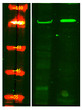


Anti-Phospho-SAMHD1-Thr592 antibody (STJ196411)
SPECIFICATIONS
ClonalityPolyclonal
HostRabbit
ConjugationUnconjugated
IsotypeIgG
ImmunogenSynthesized phosho peptide around human SAMHD1 (Thr592)
General Information
| Short Description | Rabbit polyclonal anti-Phospho-Deoxynucleoside triphosphate triphosphohydrolase SAMHD1-Thr592 for use in WB in Human, Mouse and Rat samples. Datasheet included with dilution recommendations, and related reagents. |
| Applications | WB |
| Host | Rabbit |
| Reactivity | Human/Mouse/Rat |
| Note | STRICTLY FOR FURTHER SCIENTIFIC RESEARCH USE ONLY (RUO). MUST NOT TO BE USED IN DIAGNOSTIC OR THERAPEUTIC APPLICATIONS. |
Product Properties
| Clonality | Polyclonal |
| Isotype | IgG |
| Conjugation | Unconjugated |
| Concentration | 1 mg/mL |
| Purification | The antibody was affinity-purified from rabbit serum by affinity-chromatography using specific immunogen. |
| Dilution Range | WB 1:1000-2000 |
| Formulation | Liquid in PBS containing 50% Glycerol, 0.5% BSA and 0.02% Sodium Azide. |
| Storage Instruction | Store at-20°C for up to 1 year from the date of receipt, and avoid repeat freeze-thaw cycles. |
Target Information
| Gene Symbol | SAMHD1 |
| Gene ID | 25939 |
| Uniprot ID | SAMH1_HUMAN |
| Immunogen | Synthesized phosho peptide around human SAMHD1 (Thr592) |
| Specificity | This antibody detects endogenous levels of Human Mouse Rat SAMHD1 (phospho-Thr592) |
Additional Info
| Post Translational Modifications | Phosphorylation at Thr-592 by CDK1 acts as a switch to control deoxynucleoside triphosphate (dNTPase)-dependent and -independent functions. Phosphorylation at Thr-592 takes place in cycling cells: it reduces the stability of the homotetramer, impairing the dNTPase activity and subsequent ability to restrict infection by viruses. It also inhibits ability to suppress LINE-1 retrotransposon activity. In contrast, phosphorylation at Thr-592 promotes DNA end resection at stalled replication forks in response to DNA damage. (Microbial infection) Phosphorylation at Thr-592 by Epstein-Barr virus kinase BGLF4 and human cytomegalovirus/HCMV UL97 leads to a reduced level of dCTPase and dTTPase activity and the loss of viral restriction. (Microbial infection) Ubiquitinated following interaction with HIV-2 viral protein Vpx.Vpx promotes interaction and with a DCX (DDB1-CUL4-X-box) E3 ubiquitin ligase, leading to proteasomal degradation. |
| Function | Protein that acts both as a host restriction factor involved in defense response to virus and as a regulator of DNA end resection at stalled replication forks. Has deoxynucleoside triphosphate (dNTPase) activity, which is required to restrict infection by viruses, such as HIV-1: dNTPase activity reduces cellular dNTP levels to levels too low for retroviral reverse transcription to occur, blocking early-stage virus replication in dendritic and other myeloid cells. Likewise, suppresses LINE-1 retrotransposon activity. Not able to restrict infection by HIV-2 virus.because restriction activity is counteracted by HIV-2 viral protein Vpx. In addition to virus restriction, dNTPase activity acts as a regulator of DNA precursor pools by regulating dNTP pools. Phosphorylation at Thr-592 acts as a switch to control dNTPase-dependent and -independent functions: it inhibits dNTPase activity and ability to restrict infection by viruses, while it promotes DNA end resection at stalled replication forks. Functions during S phase at stalled DNA replication forks to promote the resection of gapped or reversed forks: acts by stimulating the exonuclease activity of MRE11, activating the ATR-CHK1 pathway and allowing the forks to restart replication. Its ability to promote degradation of nascent DNA at stalled replication forks is required to prevent induction of type I interferons, thereby preventing chronic inflammation. Ability to promote DNA end resection at stalled replication forks is independent of dNTPase activity. Enhances immunoglobulin hypermutation in B-lymphocytes by promoting transversion mutation. |
| Protein Name | Deoxynucleoside Triphosphate Triphosphohydrolase Samhd1DntpaseDendritic Cell-Derived Ifng-Induced ProteinDcipMonocyte Protein 5Mop-5Sam Domain And Hd Domain-Containing Protein 1Hsamhd1 |
| Database Links | Reactome: R-HSA-8956319Reactome: R-HSA-909733 |
| Cellular Localisation | NucleusChromosomeLocalizes To Sites Of Dna Double-Strand Breaks In Response To Dna Damage |
| Alternative Antibody Names | Anti-Deoxynucleoside Triphosphate Triphosphohydrolase Samhd1 antibodyAnti-Dntpase antibodyAnti-Dendritic Cell-Derived Ifng-Induced Protein antibodyAnti-Dcip antibodyAnti-Monocyte Protein 5 antibodyAnti-Mop-5 antibodyAnti-Sam Domain And Hd Domain-Containing Protein 1 antibodyAnti-Hsamhd1 antibodyAnti-SAMHD1 antibodyAnti-MOP5 antibody |
Information sourced from Uniprot.org