


Anti-Phospho-IRE1-Ser724 antibody (STJA0004899)
SPECIFICATIONS
ClonalityPolyclonal
HostRabbit
ConjugationUnconjugated
IsotypeIgG
ImmunogenSynthetic phosphopeptide corresponding to amino acid residues surrounding the phospho-Ser724 of mouse IRE1, conjugated to keyhole limpet hemocyanin (KLH).
General Information
| Short Description | Rabbit polyclonal anti-Phospho-IRE1-Ser724 for use in WB in Mouse and Human samples. Datasheet included with dilution recommendations, and related reagents. |
| Applications | WB |
| Host | Rabbit |
| Reactivity | Mouse/Human |
| Note | STRICTLY FOR FURTHER SCIENTIFIC RESEARCH USE ONLY (RUO). MUST NOT TO BE USED IN DIAGNOSTIC OR THERAPEUTIC APPLICATIONS. |
Product Properties
| Clonality | Polyclonal |
| Isotype | IgG |
| Conjugation | Unconjugated |
| Purification | Antigen Affinity Purified from Pooled Serum |
| Dilution Range | WB 1:1000 |
| Formulation | 10 mM HEPES (pH 7.5) , 150 mM NaCl, 100 µg per ml BSA and 50% glycerol. |
| Storage Instruction | Store at-20°C for up to 1 year from the date of receipt, and avoid repeat freeze-thaw cycles. |
Target Information
| Gene Symbol | ERN1 |
| Gene ID | 2081 |
| Uniprot ID | ERN1_HUMAN |
| Immunogen | Synthetic phosphopeptide corresponding to amino acid residues surrounding the phospho-Ser724 of mouse IRE1, conjugated to keyhole limpet hemocyanin (KLH). |
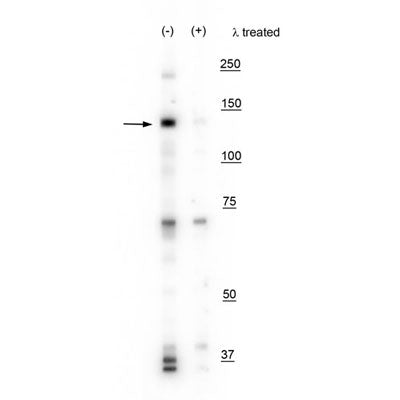
| Specificity | Specific for endogenous levels of the ~130 kDa GluR1 protein phosphorylated at Ser724. Immunolabeling is completely eliminated by treatment with Lambda-phosphatase. |
Additional Info
| Tissue Specificity | Ubiquitously expressed. High levels observed in pancreatic tissue. |
| Post Translational Modifications | Autophosphorylated following homodimerization. Autophosphorylation promotes activation of the endoribonuclease domain. In response to ER stress, phosphorylated at Ser-724, Ser-729 and possibly Ser-726.phosphorylation promotes oligomerization and endoribonuclease activity. Dephosphorylated at Ser-724, Ser-729 and possibly Ser-726 by RPAP2 to abort failed ER-stress adaptation and trigger apoptosis. Phosphorylated at Ser-724.in response to the ER stressor tunicamycin. ADP-ribosylated by PARP16 upon ER stress, which increases both kinase and endonuclease activities. |
| Function | Serine/threonine-protein kinase and endoribonuclease that acts as a key sensor for the endoplasmic reticulum unfolded protein response (UPR). In unstressed cells, the endoplasmic reticulum luminal domain is maintained in its inactive monomeric state by binding to the endoplasmic reticulum chaperone HSPA5/BiP. Accumulation of misfolded proteins in the endoplasmic reticulum causes release of HSPA5/BiP, allowing the luminal domain to homodimerize, promoting autophosphorylation of the kinase domain and subsequent activation of the endoribonuclease activity. The endoribonuclease activity is specific for XBP1 mRNA and excises 26 nucleotides from XBP1 mRNA. The resulting spliced transcript of XBP1 encodes a transcriptional activator protein that up-regulates expression of UPR target genes. Acts as an upstream signal for ER stress-induced GORASP2-mediated unconventional (ER/Golgi-independent) trafficking of CFTR to cell membrane by modulating the expression and localization of SEC16A. |
| Protein Name | Serine/Threonine-Protein Kinase/Endoribonuclease Ire1Endoplasmic Reticulum-To-Nucleus Signaling 1Inositol-Requiring Protein 1Hire1pIre1-AlphaIre1a Includes - Serine/Threonine-Protein Kinase - Endoribonuclease |
| Database Links | Reactome: R-HSA-381070 |
| Cellular Localisation | Endoplasmic Reticulum MembraneSingle-Pass Type I Membrane Protein |
| Alternative Antibody Names | Anti-Serine/Threonine-Protein Kinase/Endoribonuclease Ire1 antibodyAnti-Endoplasmic Reticulum-To-Nucleus Signaling 1 antibodyAnti-Inositol-Requiring Protein 1 antibodyAnti-Hire1p antibodyAnti-Ire1-Alpha antibodyAnti-Ire1a Includes - Serine/Threonine-Protein Kinase - Endoribonuclease antibodyAnti-ERN1 antibodyAnti-IRE1 antibody |
Information sourced from Uniprot.org