

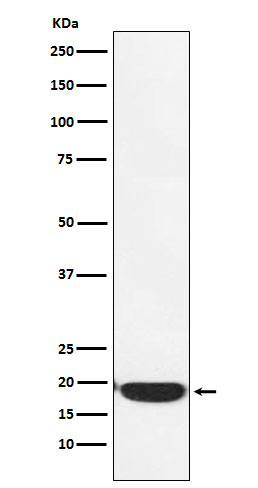

Anti-PERP antibody [R09-2O8] (STJA0036767)
SPECIFICATIONS
ClonalityMonoclonal
HostRabbit
ConjugationUnconjugated
IsotypeIgG
ImmunogenA synthesized peptide derived from human PERP
General Information
| Short Description | Rabbit monoclonal anti-PERP for use in WB, ICC and IF in Human, Mouse and Rat samples. Datasheet included with dilution recommendations, and related reagents. |
| Applications | WB/ICC/IF |
| Host | Rabbit |
| Reactivity | Human/Mouse/Rat |
| Note | STRICTLY FOR FURTHER SCIENTIFIC RESEARCH USE ONLY (RUO). MUST NOT TO BE USED IN DIAGNOSTIC OR THERAPEUTIC APPLICATIONS. |
Product Properties
| Clonality | Monoclonal |
| Clone ID | R09-2O8 |
| Isotype | IgG |
| Conjugation | Unconjugated |
| Purification | Affinity Chromatography |
| Dilution Range | WB 1:500-1:1000IF 1:50-1:200 |
| Formulation | Rabbit IgG in phosphate buffered saline, pH 7.4, 150mM NaCl, 0.02% sodium azide and 50% glycerol. |
| Storage Instruction | Store at 4°C short term. Aliquot and store at-20°C long term. Avoid freeze/thaw cycles. |
Target Information
| Gene Symbol | PERP |
| Gene ID | 64065 |
| Uniprot ID | PERP_HUMAN |
| Immunogen | A synthesized peptide derived from human PERP |
Additional Info
| Tissue Specificity | Expressed in skin, heart, placental, liver, pancreas, keratinocytes and dermal fibroblasts. May translocate to the intestinal apical epithelial cell surface via sipA and sctB1/sipC-promoted exocytic translocation following infection by S. Typhimurium. |
| Function | Component of intercellular desmosome junctions. Plays a role in stratified epithelial integrity and cell-cell adhesion by promoting desmosome assembly. Thereby plays a role in barrier function of the skin against infection. Plays a role in mammary epithelial tissue homeostasis and remodeling during and after pregnancy, potentially via its involvement in desmosome cell-cell junctions. Required for tooth enamel development via facilitating desmosome-mediated ameloblast adhesion to the stratum intermedium during the transitional stage of amelogenesis. May also play a role in downstream transcriptional regulation of other genes involved in amelogenesis such as AMBN, ENAM, MMP20 and KLK4. Plays a role as an effector in the TP53-dependent apoptotic pathway. Positively regulates apoptosis in T-helper 17 (Th17) cell populations via caspase-dependent signaling. Promotes neutrophil transepithelial migration in response to chemoattractants such as hepoxilin A3 (HXA3), N-Formylmethionyl-leucyl-phenylalanine (fMLP) and CXCL8/IL-8. Required for neutrophil transepithelial migration in response to S.typhimurium infection. May act as a positive regulator of endothelial cell apoptosis in response to blood flow-derived shear stress. |
| Protein Name | P53 Apoptosis Effector Related To Pmp-22Keratinocyte-Associated Protein 1Kcp-1P53-Induced Protein Pigpc1Transmembrane Protein Thw |
| Database Links | Reactome: R-HSA-6803205Reactome: R-HSA-6809371 |
| Cellular Localisation | Cell JunctionDesmosomeCell MembraneMulti-Pass Membrane ProteinCytoplasmAssociated With DesmosomesColocalizes With Krt14 In The Cell MembraneClusters In A Punctate Pattern Throughout The Epithelial CytoplasmIn Response To STyphimurium Infection |
| Alternative Antibody Names | Anti-P53 Apoptosis Effector Related To Pmp-22 antibodyAnti-Keratinocyte-Associated Protein 1 antibodyAnti-Kcp-1 antibodyAnti-P53-Induced Protein Pigpc1 antibodyAnti-Transmembrane Protein Thw antibodyAnti-PERP antibodyAnti-KCP1 antibodyAnti-KRTCAP1 antibodyAnti-PIGPC1 antibodyAnti-THW antibody |
Information sourced from Uniprot.org