

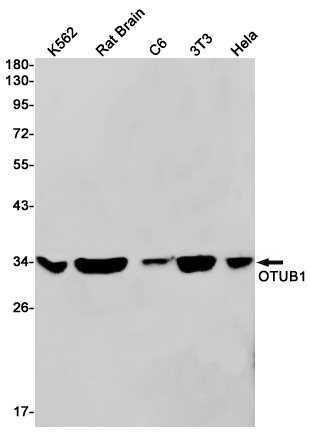

Anti-OTUB1 antibody [R04-6I3] (STJA0034667)
SPECIFICATIONS
ClonalityMonoclonal
HostRabbit
ConjugationUnconjugated
IsotypeIgG
ImmunogenA synthetic peptide of human OTUB1
General Information
| Short Description | Rabbit monoclonal anti-OTUB1 for use in WB and IP in Human, Mouse and Rat samples. Datasheet included with dilution recommendations, and related reagents. |
| Applications | WB/IP |
| Host | Rabbit |
| Reactivity | Human/Mouse/Rat |
| Note | STRICTLY FOR FURTHER SCIENTIFIC RESEARCH USE ONLY (RUO). MUST NOT TO BE USED IN DIAGNOSTIC OR THERAPEUTIC APPLICATIONS. |
Product Properties
| Clonality | Monoclonal |
| Clone ID | R04-6I3 |
| Isotype | IgG |
| Conjugation | Unconjugated |
| Concentration | 0.3 mg/mL |
| Purification | Affinity Purified |
| Dilution Range | WB 1:500-1:1000IP 1:20 |
| Formulation | 50mM Tris-Glycine (pH 7.4) , 0.15M NaCl, 40% Glycerol, 0.01% Sodium azide and 0.05% BSA |
| Storage Instruction | Store at 4°C short term. Aliquot and store at-20°C long term. Avoid freeze/thaw cycles. |
Target Information
| Gene Symbol | OTUB1 |
| Gene ID | 55611 |
| Uniprot ID | OTUB1_HUMAN |
| Immunogen | A synthetic peptide of human OTUB1 |
Additional Info
| Tissue Specificity | Isoform 1 is ubiquitous. Isoform 2 is expressed only in lymphoid tissues such as tonsils, lymph nodes and spleen, as well as peripheral blood mononuclear cells. |
| Post Translational Modifications | Phosphorylation at Tyr-26 by SRC and SRMS promotes deubiquitination of RPTOR via a non-catalytic process. |
| Function | Hydrolase that can specifically remove 'Lys-48'-linked conjugated ubiquitin from proteins and plays an important regulatory role at the level of protein turnover by preventing degradation. Regulator of T-cell anergy, a phenomenon that occurs when T-cells are rendered unresponsive to antigen rechallenge and no longer respond to their cognate antigen. Acts via its interaction with RNF128/GRAIL, a crucial inductor of CD4 T-cell anergy. Isoform 1 destabilizes RNF128, leading to prevent anergy. In contrast, isoform 2 stabilizes RNF128 and promotes anergy. Surprisingly, it regulates RNF128-mediated ubiquitination, but does not deubiquitinate polyubiquitinated RNF128. Deubiquitinates estrogen receptor alpha (ESR1). Mediates deubiquitination of 'Lys-48'-linked polyubiquitin chains, but not 'Lys-63'-linked polyubiquitin chains. Not able to cleave di-ubiquitin. Also capable of removing NEDD8 from NEDD8 conjugates, but with a much lower preference compared to 'Lys-48'-linked ubiquitin. Plays a key non-catalytic role in DNA repair regulation by inhibiting activity of RNF168, an E3 ubiquitin-protein ligase that promotes accumulation of 'Lys-63'-linked histone H2A and H2AX at DNA damage sites. Inhibits RNF168 independently of ubiquitin thioesterase activity by binding and inhibiting UBE2N/UBC13, the E2 partner of RNF168, thereby limiting spreading of 'Lys-63'-linked histone H2A and H2AX marks. Inhibition occurs by binding to free ubiquitin: free ubiquitin acts as an allosteric regulator that increases affinity for UBE2N/UBC13 and disrupts interaction with UBE2V1. The OTUB1-UBE2N/UBC13-free ubiquitin complex adopts a configuration that mimics a cleaved 'Lys48'-linked di-ubiquitin chain. Acts as a regulator of mTORC1 and mTORC2 complexes. When phosphorylated at Tyr-26, acts as an activator of the mTORC1 complex by mediating deubiquitination of RPTOR via a non-catalytic process: acts by binding and inhibiting the activity of the ubiquitin-conjugating enzyme E2 (UBE2D1/UBCH5A, UBE2W/UBC16 and UBE2N/UBC13), thereby preventing ubiquitination of RPTOR. Can also act as an inhibitor of the mTORC1 and mTORC2 complexes in response to amino acids by mediating non-catalytic deubiquitination of DEPTOR. |
| Protein Name | Ubiquitin Thioesterase Otub1Deubiquitinating Enzyme Otub1Otu Domain-Containing Ubiquitin Aldehyde-Binding Protein 1Otubain-1Hotu1Ubiquitin-Specific-Processing Protease Otub1 |
| Database Links | Reactome: R-HSA-5689880Reactome: R-HSA-5689896 |
| Cellular Localisation | Cytoplasm |
| Alternative Antibody Names | Anti-Ubiquitin Thioesterase Otub1 antibodyAnti-Deubiquitinating Enzyme Otub1 antibodyAnti-Otu Domain-Containing Ubiquitin Aldehyde-Binding Protein 1 antibodyAnti-Otubain-1 antibodyAnti-Hotu1 antibodyAnti-Ubiquitin-Specific-Processing Protease Otub1 antibodyAnti-OTUB1 antibodyAnti-OTB1 antibodyAnti-OTU1 antibodyAnti-HSPC263 antibody |
Information sourced from Uniprot.org