
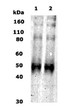


Anti-OPRK1 antibody (C-Term) (STJA0005799)
SPECIFICATIONS
ClonalityPolyclonal
HostRabbit
ConjugationUnconjugated
IsotypeIgG
ImmunogenSynthetic peptide corresponding to amino acids from the C-terminal region of the human KOR-1 protein
General Information
| Short Description | Rabbit polyclonal anti-Kappa Opioid Receptor (C-Term) for use in WB in Human samples. Datasheet included with dilution recommendations, and related reagents. |
| Applications | WB |
| Host | Rabbit |
| Reactivity | Human |
| Note | STRICTLY FOR FURTHER SCIENTIFIC RESEARCH USE ONLY (RUO). MUST NOT TO BE USED IN DIAGNOSTIC OR THERAPEUTIC APPLICATIONS. |
Product Properties
| Clonality | Polyclonal |
| Isotype | IgG |
| Conjugation | Unconjugated |
| Purification | Antigen Affinity Purified |
| Dilution Range | WB 1:500-1:1000 |
| Formulation | PBS + 0.02% NaN3 |
| Storage Instruction | Store at-20°C for up to 1 year from the date of receipt, and avoid repeat freeze-thaw cycles. |
Target Information
| Gene Symbol | OPRK1 |
| Gene ID | 4986 |
| Uniprot ID | OPRK_HUMAN |
| Immunogen | Synthetic peptide corresponding to amino acids from the C-terminal region of the human KOR-1 protein |
| Immunogen Region | C-Term |
| Specificity | Reacts with the C-terminal region of the human KOR-1 protein. Sequence identity is 66% in mouse and rat. |
Additional Info
| Function | G-protein coupled opioid receptor that functions as a receptor for endogenous alpha-neoendorphins and dynorphins, but has low affinity for beta-endorphins. Also functions as a receptor for various synthetic opioids and for the psychoactive diterpene salvinorin A. Ligand binding causes a conformation change that triggers signaling via guanine nucleotide-binding proteins (G proteins) and modulates the activity of down-stream effectors, such as adenylate cyclase. Signaling leads to the inhibition of adenylate cyclase activity. Inhibits neurotransmitter release by reducing calcium ion currents and increasing potassium ion conductance. Plays a role in the perception of pain. Plays a role in mediating reduced physical activity upon treatment with synthetic opioids. Plays a role in the regulation of salivation in response to synthetic opioids. May play a role in arousal and regulation of autonomic and neuroendocrine functions. |
| Protein Name | Kappa-Type Opioid ReceptorK-Or-1Kor-1 |
| Database Links | Reactome: R-HSA-375276Reactome: R-HSA-418594Reactome: R-HSA-9022699 |
| Cellular Localisation | Cell MembraneMulti-Pass Membrane Protein |
| Alternative Antibody Names | Anti-Kappa-Type Opioid Receptor antibodyAnti-K-Or-1 antibodyAnti-Kor-1 antibodyAnti-OPRK1 antibodyAnti-OPRK antibody |
Information sourced from Uniprot.org