

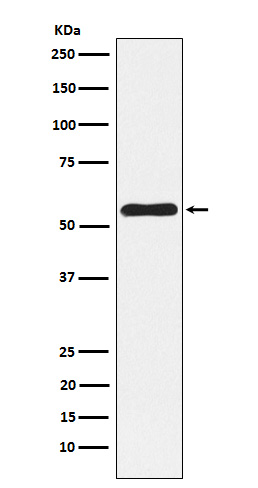

Anti-NLK antibody [R03-2K8] (STJA0037427)
SPECIFICATIONS
ClonalityMonoclonal
HostRabbit
ConjugationUnconjugated
IsotypeIgG
ImmunogenA synthesized peptide derived from human NLK
General Information
| Short Description | Rabbit monoclonal anti-NLK for use in WB and FC in Human samples. Datasheet included with dilution recommendations, and related reagents. |
| Applications | WB/FC |
| Host | Rabbit |
| Reactivity | Human |
| Note | STRICTLY FOR FURTHER SCIENTIFIC RESEARCH USE ONLY (RUO). MUST NOT TO BE USED IN DIAGNOSTIC OR THERAPEUTIC APPLICATIONS. |
Product Properties
| Clonality | Monoclonal |
| Clone ID | R03-2K8 |
| Isotype | IgG |
| Conjugation | Unconjugated |
| Purification | Affinity Purified |
| Dilution Range | WB 1:500-1:1000FC 1:50-1:100 |
| Formulation | Rabbit IgG in phosphate buffered saline, pH 7.4, 150mM NaCl, 0.02% sodium azide and 50% glycerol. |
| Storage Instruction | Store at 4°C short term. Aliquot and store at-20°C long term. Avoid freeze/thaw cycles. |
Target Information
| Gene Symbol | NLK |
| Gene ID | 51701 |
| Uniprot ID | NLK_HUMAN |
| Immunogen | A synthesized peptide derived from human NLK |
Additional Info
| Post Translational Modifications | Phosphorylated on Thr-298. Intermolecular autophosphorylation on Thr-298 activates the enzyme. |
| Function | Serine/threonine-protein kinase that regulates a number of transcription factors with key roles in cell fate determination. Positive effector of the non-canonical Wnt signaling pathway, acting downstream of WNT5A, MAP3K7/TAK1 and HIPK2. Negative regulator of the canonical Wnt/beta-catenin signaling pathway. Binds to and phosphorylates TCF7L2/TCF4 and LEF1, promoting the dissociation of the TCF7L2/LEF1/beta-catenin complex from DNA, as well as the ubiquitination and subsequent proteolysis of LEF1. Together these effects inhibit the transcriptional activation of canonical Wnt/beta-catenin target genes. Negative regulator of the Notch signaling pathway. Binds to and phosphorylates NOTCH1, thereby preventing the formation of a transcriptionally active ternary complex of NOTCH1, RBPJ/RBPSUH and MAML1. Negative regulator of the MYB family of transcription factors. Phosphorylation of MYB leads to its subsequent proteolysis while phosphorylation of MYBL1 and MYBL2 inhibits their interaction with the coactivator CREBBP. Other transcription factors may also be inhibited by direct phosphorylation of CREBBP itself. Acts downstream of IL6 and MAP3K7/TAK1 to phosphorylate STAT3, which is in turn required for activation of NLK by MAP3K7/TAK1. Upon IL1B stimulus, cooperates with ATF5 to activate the transactivation activity of C/EBP subfamily members. Phosphorylates ATF5 but also stabilizes ATF5 protein levels in a kinase-independent manner. Acts as an inhibitor of the mTORC1 complex in response to osmotic stress by mediating phosphorylation of RPTOR, thereby preventing recruitment of the mTORC1 complex to lysosomes. |
| Protein Name | Serine/Threonine-Protein Kinase NlkNemo-Like KinaseProtein Lak1 |
| Database Links | Reactome: R-HSA-4086398 |
| Cellular Localisation | NucleusCytoplasmPredominantly NuclearA Smaller Fraction Is Cytoplasmic |
| Alternative Antibody Names | Anti-Serine/Threonine-Protein Kinase Nlk antibodyAnti-Nemo-Like Kinase antibodyAnti-Protein Lak1 antibodyAnti-NLK antibodyAnti-LAK1 antibody |
Information sourced from Uniprot.org