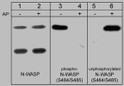
| Short Description : | Rabbit polyclonal anti-N-WASP (N-Term) for use in ELISA and WB in Human, Mouse and Rat samples. Datasheet included with dilution recommendations, and related reagents. |
| Applications: | ELISA/WB |
| Host: | Rabbit |
| Reactivity: | Human/Mouse/Rat |
| Note: | STRICTLY FOR FURTHER SCIENTIFIC RESEARCH USE ONLY (RUO). MUST NOT TO BE USED IN DIAGNOSTIC OR THERAPEUTIC APPLICATIONS. |
| Clonality : | Polyclonal |
| Isotype: | IgG |
| Conjugation: | Unconjugated |
| Purification: | Antigen Affinity Purified |
| Dilution Range: | WB 1:1000 |
| Formulation: | PBS + 1 mg/ml BSA, 0.05% NaN3 and 50% glycerol |
| Storage Instruction: | Storage at-20°C is recommended, as aliquots may be taken without freeze/thawing due to presence of 50% glycerol. Stable for at least 1 year at-20°C. |
| Gene Symbol: | WASL |
| Gene ID: | 8976 |
| Uniprot ID: | WASL_HUMAN |
| Immunogen: | N-WASP synthetic peptide (coupled to KLH) corresponding to amino acid residues in the N-terminal region of human N-WASP. This N-WASP peptide sequence is 100% homologous to rat and mouse N-WASP, and has low homology to the corresponding region in the |
| Immunogen Region: | N-Term |
| Immunogen Sequence: | Human |
| Specificity: | This antibody detects a 65 kDa* protein corresponding to the molecular mass of N-WASP on SDS-PAGE immunoblots of neonatal rat brain lysate. It is also detects 65 kDa* proteins in A431, human endothelial, and SKN-SH cells. It does not recognize the 63 |
| Post Translational Modifications | Phosphorylation at Ser-242, Tyr-256, Ser-484 and Ser-485 enhances actin polymerization activity. |
| Function | Regulates actin polymerization by stimulating the actin-nucleating activity of the Arp2/3 complex. Involved in various processes, such as mitosis and cytokinesis, via its role in the regulation of actin polymerization. Together with CDC42, involved in the extension and maintenance of the formation of thin, actin-rich surface projections called filopodia. In addition to its role in the cytoplasm, also plays a role in the nucleus by regulating gene transcription, probably by promoting nuclear actin polymerization. Binds to HSF1/HSTF1 and forms a complex on heat shock promoter elements (HSE) that negatively regulates HSP90 expression. Plays a role in dendrite spine morphogenesis. Decreasing levels of DNMBP (using antisense RNA) alters apical junction morphology in cultured enterocytes, junctions curve instead of being nearly linear. |
| Protein Name | Actin Nucleation-Promoting Factor WaslNeural Wiskott-Aldrich Syndrome ProteinN-Wasp |
| Database Links | Reactome: R-HSA-2029482Reactome: R-HSA-203641Reactome: R-HSA-373753Reactome: R-HSA-3928662Reactome: R-HSA-418885Reactome: R-HSA-5663213Reactome: R-HSA-8856828Reactome: R-HSA-9013148Reactome: R-HSA-9013149Reactome: R-HSA-9013406Reactome: R-HSA-9013409Reactome: R-HSA-9013424Reactome: R-HSA-9664422 |
| Cellular Localisation | CytoplasmCytoskeletonNucleusPreferentially Localized In The Cytoplasm When Phosphorylated And In The Nucleus When UnphosphorylatedExported From The Nucleus By An Nuclear Export Signal (Nes)-Dependent Mechanism To The Cytoplasm |
| Alternative Antibody Names | Anti-Actin Nucleation-Promoting Factor Wasl antibodyAnti-Neural Wiskott-Aldrich Syndrome Protein antibodyAnti-N-Wasp antibodyAnti-WASL antibody |
Information sourced from Uniprot.org