



Anti-Memo antibody (N-Term) (STJA0041271)
SPECIFICATIONS
ClonalityPolyclonal
HostRabbit
ConjugationUnconjugated
IsotypeIgG
ImmunogenMemo synthetic peptide (coupled to KLH) corresponding to amino acid residues in the N-terminal region of human Memo. This peptide sequence is highly conserved in rat, mouse, and chicken Memo.
General Information
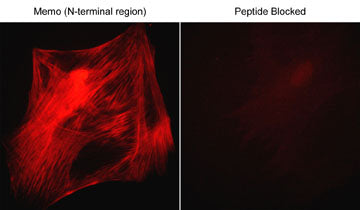
| Short Description | Rabbit polyclonal anti-Memo (N-Term) for use in ELISA, WB and ICC in Chicken, Human, Mouse and Rat samples. Datasheet included with dilution recommendations, and related reagents. |
| Applications | ELISA/WB/ICC |
| Host | Rabbit |
| Reactivity | Chicken/Human/Mouse/Rat |
| Note | STRICTLY FOR FURTHER SCIENTIFIC RESEARCH USE ONLY (RUO). MUST NOT TO BE USED IN DIAGNOSTIC OR THERAPEUTIC APPLICATIONS. |
Product Properties
| Clonality | Polyclonal |
| Isotype | IgG |
| Conjugation | Unconjugated |
| Purification | Antigen Affinity Purified |
| Dilution Range | WB 1:1000ICC 1:200 |
| Formulation | PBS + 1 mg/ml BSA, 0.05% NaN3 and 50% glycerol |
| Storage Instruction | Storage at-20°C is recommended, as aliquots may be taken without freeze/thawing due to presence of 50% glycerol. Stable for at least 1 year at-20°C. |
Target Information
| Gene Symbol | MEMO1 |
| Gene ID | 51072 |
| Uniprot ID | MEMO1_HUMAN |
| Immunogen | Memo synthetic peptide (coupled to KLH) corresponding to amino acid residues in the N-terminal region of human Memo. This peptide sequence is highly conserved in rat, mouse, and chicken Memo. |
| Immunogen Region | N-Term |
| Immunogen Sequence | Human |
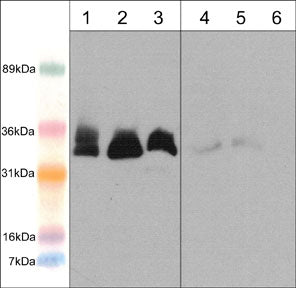
| Specificity | The antibody detects a significant 33 kDa* protein corresponding to the molecular mass of Memo on SDS-PAGE immunoblots of mouse heart, mouse C2C12, and rabbit spleen fibroblasts. |
Additional Info
| Function | May control cell migration by relaying extracellular chemotactic signals to the microtubule cytoskeleton. Mediator of ERBB2 signaling. The MEMO1-RHOA-DIAPH1 signaling pathway plays an important role in ERBB2-dependent stabilization of microtubules at the cell cortex. It controls the localization of APC and CLASP2 to the cell membrane, via the regulation of GSK3B activity. In turn, membrane-bound APC allows the localization of the MACF1 to the cell membrane, which is required for microtubule capture and stabilization. Is required for breast carcinoma cell migration. |
| Protein Name | Protein Memo1C21orf19-Like ProteinHepatitis C Virus Ns5a-Transactivated Protein 7Hcv Ns5a-Transactivated Protein 7Mediator Of Erbb2-Driven Cell Motility 1Mediator Of Cell Motility 1Memo-1 |
| Database Links | Reactome: R-HSA-6785631 |
| Cellular Localisation | |
| Alternative Antibody Names | Anti-Protein Memo1 antibodyAnti-C21orf19-Like Protein antibodyAnti-Hepatitis C Virus Ns5a-Transactivated Protein 7 antibodyAnti-Hcv Ns5a-Transactivated Protein 7 antibodyAnti-Mediator Of Erbb2-Driven Cell Motility 1 antibodyAnti-Mediator Of Cell Motility 1 antibodyAnti-Memo-1 antibodyAnti-MEMO1 antibodyAnti-C2orf4 antibodyAnti-MEMO antibodyAnti-NS5ATP7 antibodyAnti-CGI-27 antibody |
Information sourced from Uniprot.org