


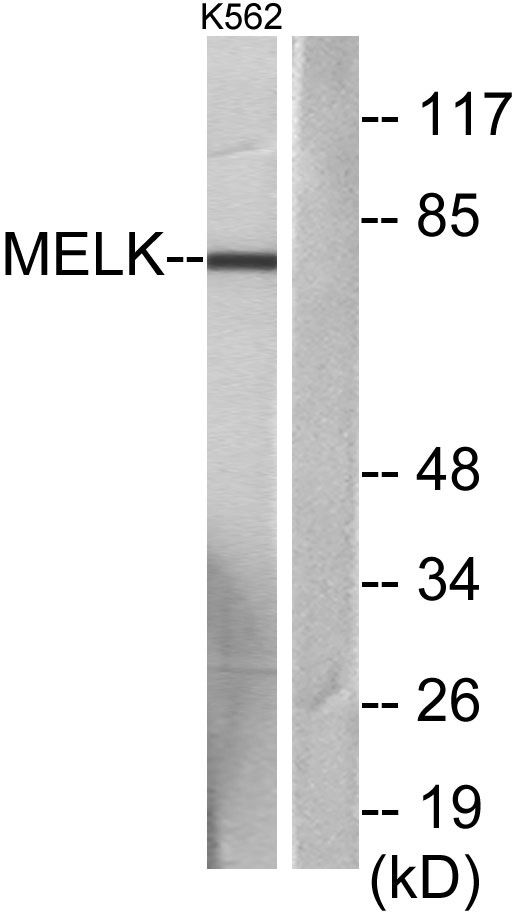
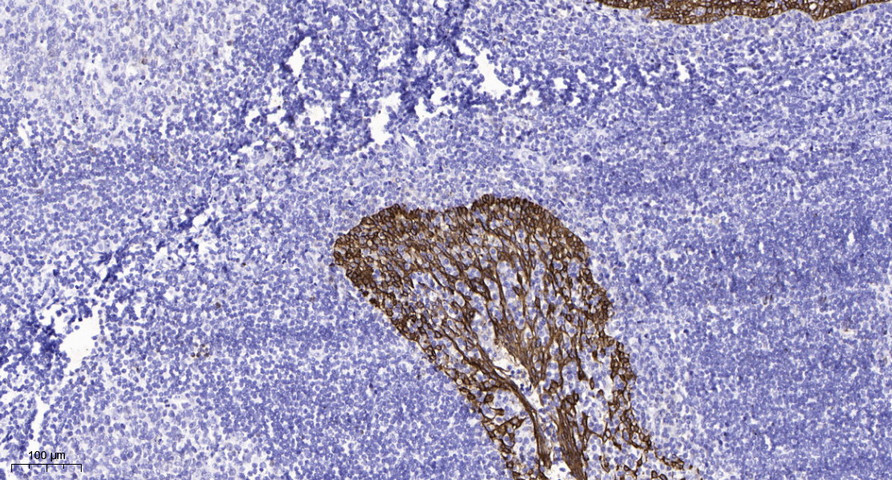

Anti-MELK antibody (431-480 aa) (STJ94095)
SPECIFICATIONS
ClonalityPolyclonal
HostRabbit
ConjugationUnconjugated
IsotypeIgG
ImmunogenThe antiserum was produced against synthesized peptide derived from the human MELK at the amino acid range 431-480
General Information
| Short Description | Rabbit polyclonal anti-Maternal embryonic leucine zipper kinase (431-480 aa) for use in WB, IHC, IF and ELISA in Human, Rat and Mouse samples. Datasheet included with dilution recommendations, and related reagents. |
| Applications | WB/IHC/IF/ELISA |
| Host | Rabbit |
| Reactivity | Human/Rat/Mouse |
| Note | STRICTLY FOR FURTHER SCIENTIFIC RESEARCH USE ONLY (RUO). MUST NOT TO BE USED IN DIAGNOSTIC OR THERAPEUTIC APPLICATIONS. |
Product Properties
| Clonality | Polyclonal |
| Isotype | IgG |
| Conjugation | Unconjugated |
| Concentration | 1 mg/mL |
| Purification | The antibody was affinity-purified from rabbit antiserum by affinity-chromatography using epitope-specific immunogen. |
| Dilution Range | WB 1:500-1:2000IHC 1:100-1:300IF 1:200-1:1000ELISA 1:10000 |
| Formulation | Liquid in PBS containing 50% Glycerol, 0.5% BSA and 0.02% Sodium Azide. |
| Storage Instruction | Store at-20°C for up to 1 year from the date of receipt, and avoid repeat freeze-thaw cycles. |
Target Information
| Gene Symbol | MELK |
| Gene ID | 9833 |
| Uniprot ID | MELK_HUMAN |
| Immunogen | The antiserum was produced against synthesized peptide derived from the human MELK at the amino acid range 431-480 |
| Immunogen Region | 431-480 aa |
| Specificity | MELK Polyclonal Antibody detects endogenous levels of MELK protein. |
Additional Info
| Post Translational Modifications | Autophosphorylated: autophosphorylation of the T-loop at Thr-167 and Ser-171 is required for activation. Thr-478 phosphorylation during mitosis promotes interaction with PPP1R8 (Probable). |
| Function | Serine/threonine-protein kinase involved in various processes such as cell cycle regulation, self-renewal of stem cells, apoptosis and splicing regulation. Has a broad substrate specificity.phosphorylates BCL2L14, CDC25B, MAP3K5/ASK1 and ZNF622. Acts as an activator of apoptosis by phosphorylating and activating MAP3K5/ASK1. Acts as a regulator of cell cycle, notably by mediating phosphorylation of CDC25B, promoting localization of CDC25B to the centrosome and the spindle poles during mitosis. Plays a key role in cell proliferation and carcinogenesis. Required for proliferation of embryonic and postnatal multipotent neural progenitors. Phosphorylates and inhibits BCL2L14, possibly leading to affect mammary carcinogenesis by mediating inhibition of the pro-apoptotic function of BCL2L14. Also involved in the inhibition of spliceosome assembly during mitosis by phosphorylating ZNF622, thereby contributing to its redirection to the nucleus. May also play a role in primitive hematopoiesis. |
| Protein Name | Maternal Embryonic Leucine Zipper KinaseHmelkProtein Kinase Eg3Peg3 KinaseProtein Kinase Pk38Hpk38Tyrosine-Protein Kinase Melk |
| Database Links | |
| Cellular Localisation | Cell MembranePeripheral Membrane Protein |
| Alternative Antibody Names | Anti-Maternal Embryonic Leucine Zipper Kinase antibodyAnti-Hmelk antibodyAnti-Protein Kinase Eg3 antibodyAnti-Peg3 Kinase antibodyAnti-Protein Kinase Pk38 antibodyAnti-Hpk38 antibodyAnti-Tyrosine-Protein Kinase Melk antibodyAnti-MELK antibodyAnti-KIAA0175 antibody |
Information sourced from Uniprot.org