

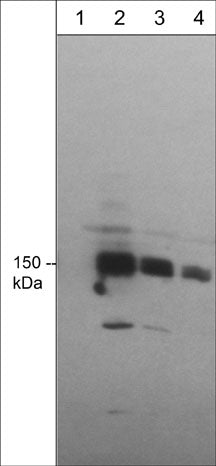

Anti-mDia1 antibody (N-Term) (STJA0041180)
SPECIFICATIONS
ClonalityPolyclonal
HostRabbit
ConjugationUnconjugated
IsotypeIgG
ImmunogenmDia1 synthetic peptide corresponding to amino acids from the N-terminal region of human mDia1 (Diap1). This peptide sequence is highly conserved in rat and mouse mDia1, and has low homology to other formins.
General Information
| Short Description | Rabbit polyclonal anti-mDia1 (N-Term) for use in ELISA and WB in Human, Mouse and Rat samples. Datasheet included with dilution recommendations, and related reagents. |
| Applications | ELISA/WB |
| Host | Rabbit |
| Reactivity | Human/Mouse/Rat |
| Note | STRICTLY FOR FURTHER SCIENTIFIC RESEARCH USE ONLY (RUO). MUST NOT TO BE USED IN DIAGNOSTIC OR THERAPEUTIC APPLICATIONS. |
Product Properties
| Clonality | Polyclonal |
| Isotype | IgG |
| Conjugation | Unconjugated |
| Purification | Antigen Affinity Purified |
| Dilution Range | WB 1:1000 |
| Formulation | PBS + 1 mg/ml BSA, 0.05% NaN3 and 50% glycerol |
| Storage Instruction | Storage at-20°C is recommended, as aliquots may be taken without freeze/thawing due to presence of 50% glycerol. Stable for at least 1 year at-20°C. |
Target Information
| Gene Symbol | DIAPH1 |
| Gene ID | 1729 |
| Uniprot ID | DIAP1_HUMAN |
| Immunogen | mDia1 synthetic peptide corresponding to amino acids from the N-terminal region of human mDia1 (Diap1). This peptide sequence is highly conserved in rat and mouse mDia1, and has low homology to other formins. |
| Immunogen Region | N-Term |
| Immunogen Sequence | Human |
| Specificity | The antibody detects a 140 kDa* protein corresponding to the apparent molecular mass of mDia1 on SDS-PAGE immunoblots of human K562, human Jurkat, and mouse C2C12 cells. |
Additional Info
| Tissue Specificity | Expressed in brain, heart, placenta, lung, kidney, pancreas, liver, skeletal muscle and cochlea. Expressed in platelets. |
| Post Translational Modifications | Phosphorylation at Thr-768 is stimulated by cAMP and regulates stability, complex formation and mitochondrial movement. |
| Function | Actin nucleation and elongation factor required for the assembly of F-actin structures, such as actin cables and stress fibers. Binds to the barbed end of the actin filament and slows down actin polymerization and depolymerization. Required for cytokinesis, and transcriptional activation of the serum response factor. DFR proteins couple Rho and Src tyrosine kinase during signaling and the regulation of actin dynamics. Functions as a scaffold protein for MAPRE1 and APC to stabilize microtubules and promote cell migration. Has neurite outgrowth promoting activity. Acts in a Rho-dependent manner to recruit PFY1 to the membrane. In hear cells, it may play a role in the regulation of actin polymerization in hair cells. The MEMO1-RHOA-DIAPH1 signaling pathway plays an important role in ERBB2-dependent stabilization of microtubules at the cell cortex. It controls the localization of APC and CLASP2 to the cell membrane, via the regulation of GSK3B activity. In turn, membrane-bound APC allows the localization of the MACF1 to the cell membrane, which is required for microtubule capture and stabilization. Plays a role in the regulation of cell morphology and cytoskeletal organization. Required in the control of cell shape. Plays a role in brain development. Also acts as an actin nucleation and elongation factor in the nucleus by promoting nuclear actin polymerization inside the nucleus to drive serum-dependent SRF-MRTFA activity. |
| Protein Name | Protein Diaphanous Homolog 1Diaphanous-Related Formin-1Drf1 |
| Database Links | Reactome: R-HSA-5663220Reactome: R-HSA-6785631Reactome: R-HSA-6798695Reactome: R-HSA-8980692Reactome: R-HSA-9013026Reactome: R-HSA-9013106Reactome: R-HSA-9013405Reactome: R-HSA-9035034Reactome: R-HSA-9854909 |
| Cellular Localisation | Cell MembraneCell ProjectionRuffle MembraneCytoplasmCytoskeletonMicrotubule Organizing CenterCentrosomeSpindleNucleusMembrane RufflesEspecially At The Tip Of RufflesOf Motile Cells |
| Alternative Antibody Names | Anti-Protein Diaphanous Homolog 1 antibodyAnti-Diaphanous-Related Formin-1 antibodyAnti-Drf1 antibodyAnti-DIAPH1 antibodyAnti-DIAP1 antibody |
Information sourced from Uniprot.org