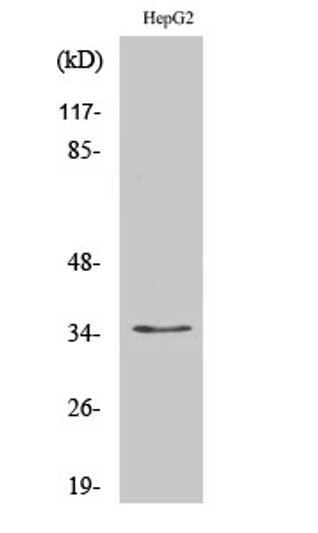
| Short Description : | Rabbit polyclonal MARVELD1 (1-50) antibody for use in WB and ELISA in human, mouse and rat samples. Datasheet included with dilution recommendations, and related reagents. |
| Applications: | WB/ELISA |
| Host: | Rabbit |
| Reactivity: | Human/Mouse/Rat |
| Note: | STRICTLY FOR FURTHER SCIENTIFIC RESEARCH USE ONLY (RUO). MUST NOT TO BE USED IN DIAGNOSTIC OR THERAPEUTIC APPLICATIONS. |
| Clonality : | Polyclonal |
| Isotype: | IgG |
| Conjugation: | Unconjugated |
| Concentration: | Lot specific |
| Purification: | Affinity purification |
| Dilution Range: | WB:1:500-1:2000ELISA:Recommended starting concentration is 1 Mu g/mL. Please optimize the concentration based on your specific assay requirements. |
| Formulation: | PBS with 0.01% Thimerosal, 50% Glycerol, pH 7.3. |
| Storage Instruction: | Store at-20°C for up to 1 year from the date of receipt, and avoid repeat freeze-thaw cycles. |
| Gene Symbol: | MARVELD1 |
| Gene ID: | 83742 |
| Uniprot ID: | MALD1_HUMAN |
| Immunogen Region: | 1-50 |
| Immunogen Sequence: | MLPPPPRQPPPQARAARGAV RLQRPFLRSPLGVLRLLQLL AGAAFWITIA |
| Specificity: | A synthetic peptide corresponding to a sequence within amino acids 1-50 of human MARVELD1 (NP_113672.1). |
| Tissue Specificity | Widely expressed in normal tissues. Down-regulated in multiple primary tumors. |
| Function | Microtubule-associated protein that exhibits cell cycle-dependent localization and can inhibit cell proliferation and migration. |
| Protein Name | Marvel Domain-Containing Protein 1 |
| Database Links | |
| Cellular Localisation | Cell MembraneMulti-Pass Membrane ProteinCytoplasmCytoskeletonNucleusObserved In The Nucleus And At The Perinuclear Region During InterphaseBut Localizes At The Mitotic Spindle And Midbody At MetaphaseA Significant Fraction Of Marveld1 Translocates To The Plasma Membrane During Anaphase Or Upon Microtubule Depolymerization |
| Alternative Antibody Names | Anti-Marvel Domain-Containing Protein 1 antibodyAnti-MARVELD1 antibodyAnti-MRVLDC1 antibody |
Information sourced from Uniprot.org