
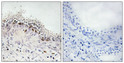


Anti-LIG4 antibody (616-665 aa) (STJ92731)
SPECIFICATIONS
ClonalityPolyclonal
HostRabbit
ConjugationUnconjugated
IsotypeIgG
ImmunogenThe antiserum was produced against synthesized peptide derived from the human DNA Ligase 4 at the amino acid range 616-665
General Information
| Short Description | Rabbit polyclonal anti-DNA ligase 4 (616-665 aa) for use in IHC, IF, WB and ELISA in Human, Rat and Mouse samples. Datasheet included with dilution recommendations, and related reagents. |
| Applications | IHC/IF/WB/ELISA |
| Host | Rabbit |
| Reactivity | Human/Rat/Mouse |
| Note | STRICTLY FOR FURTHER SCIENTIFIC RESEARCH USE ONLY (RUO). MUST NOT TO BE USED IN DIAGNOSTIC OR THERAPEUTIC APPLICATIONS. |
Product Properties
| Clonality | Polyclonal |
| Isotype | IgG |
| Conjugation | Unconjugated |
| Concentration | 1 mg/mL |
| Purification | The antibody was affinity-purified from rabbit antiserum by affinity-chromatography using epitope-specific immunogen. |
| Dilution Range | WB 1:500-2000IHC 1:100-1:300ELISA 1:20000IF 1:50-200 |
| Formulation | Liquid in PBS containing 50% Glycerol, 0.5% BSA and 0.02% Sodium Azide. |
| Storage Instruction | Store at-20°C for up to 1 year from the date of receipt, and avoid repeat freeze-thaw cycles. |
Target Information
| Gene Symbol | LIG4 |
| Gene ID | 3981 |
| Uniprot ID | DNLI4_HUMAN |
| Immunogen | The antiserum was produced against synthesized peptide derived from the human DNA Ligase 4 at the amino acid range 616-665 |
| Immunogen Region | 616-665 aa |
| Specificity | DNA Ligase IV Polyclonal Antibody detects endogenous levels of DNA Ligase IV protein. |
Additional Info
| Function | DNA ligase involved in DNA non-homologous end joining (NHEJ).required for double-strand break (DSB) repair and V(D)J recombination. Catalyzes the NHEJ ligation step of the broken DNA during DSB repair by resealing the DNA breaks after the gap filling is completed. Joins single-strand breaks in a double-stranded polydeoxynucleotide in an ATP-dependent reaction. LIG4 is mechanistically flexible: it can ligate nicks as well as compatible DNA overhangs alone, while in the presence of XRCC4, it can ligate ends with 2-nucleotides (nt) microhomology and 1-nt gaps. Forms a subcomplex with XRCC4.the LIG4-XRCC4 subcomplex is responsible for the NHEJ ligation step and XRCC4 enhances the joining activity of LIG4. Binding of the LIG4-XRCC4 complex to DNA ends is dependent on the assembly of the DNA-dependent protein kinase complex DNA-PK to these DNA ends. LIG4 regulates nuclear localization of XRCC4. |
| Protein Name | Dna Ligase 4Dna Ligase IvPolydeoxyribonucleotide Synthase Atp 4 |
| Database Links | Reactome: R-HSA-164843Reactome: R-HSA-5693571 |
| Cellular Localisation | Nucleus |
| Alternative Antibody Names | Anti-Dna Ligase 4 antibodyAnti-Dna Ligase Iv antibodyAnti-Polydeoxyribonucleotide Synthase Atp 4 antibodyAnti-LIG4 antibody |
Information sourced from Uniprot.org