

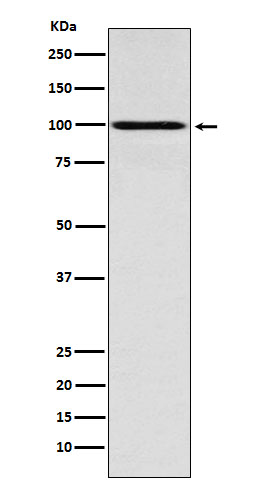

Anti-Interferon gamma Receptor 1 antibody [R03-6H3] (STJA0036993)
SPECIFICATIONS
ClonalityMonoclonal
HostRabbit
ConjugationUnconjugated
IsotypeIgG
ImmunogenA synthesized peptide derived from human IFNGR1
General Information
| Short Description | Rabbit monoclonal anti-Interferon gamma Receptor 1 for use in WB, IHC-P, ICC, IF and FC in Human samples. Datasheet included with dilution recommendations, and related reagents. |
| Applications | WB/IHC-P/ICC/IF/FC |
| Host | Rabbit |
| Reactivity | Human |
| Note | STRICTLY FOR FURTHER SCIENTIFIC RESEARCH USE ONLY (RUO). MUST NOT TO BE USED IN DIAGNOSTIC OR THERAPEUTIC APPLICATIONS. |
Product Properties
| Clonality | Monoclonal |
| Clone ID | R03-6H3 |
| Isotype | IgG |
| Conjugation | Unconjugated |
| Purification | Affinity Chromatography |
| Dilution Range | WB 1:500-1:1000IHC 1:50-1:100IF 1:50-1:200FC 1:50-1:100 |
| Formulation | Rabbit IgG in phosphate buffered saline, pH 7.4, 150mM NaCl, 0.02% sodium azide and 50% glycerol. |
| Storage Instruction | Store at 4°C short term. Aliquot and store at-20°C long term. Avoid freeze/thaw cycles. |
Target Information
| Gene Symbol | IFNGR1 |
| Gene ID | 3459 |
| Uniprot ID | INGR1_HUMAN |
| Immunogen | A synthesized peptide derived from human IFNGR1 |
Additional Info
| Post Translational Modifications | Phosphorylated at Ser/Thr residues. Phosphorylation of Tyr-457 is required for IFNG receptor signal transduction. Influenza virus infection leads to phosphorylation in a CSNK1A1-dependent manner. Ubiquitinated after phosphorylation in a CSNK1A1-dependent manner, leading to the lysosome-dependent degradation. Proteasomally degraded through 'Lys-48'-mediated ubiquitination. Ubiquitination is necessary for efficient IFNGR1 signaling. |
| Function | Receptor subunit for interferon gamma/INFG that plays crucial roles in antimicrobial, antiviral, and antitumor responses by activating effector immune cells and enhancing antigen presentation. Associates with transmembrane accessory factor IFNGR2 to form a functional receptor. Upon ligand binding, the intracellular domain of IFNGR1 opens out to allow association of downstream signaling components JAK1 and JAK2. In turn, activated JAK1 phosphorylates IFNGR1 to form a docking site for STAT1. Subsequent phosphorylation of STAT1 leads to dimerization, translocation to the nucleus, and stimulation of target gene transcription. STAT3 can also be activated in a similar manner although activation seems weaker. IFNGR1 intracellular domain phosphorylation also provides a docking site for SOCS1 that regulates the JAK-STAT pathway by competing with STAT1 binding to IFNGR1. |
| Protein Name | Interferon Gamma Receptor 1Ifn-Gamma Receptor 1Ifn-Gamma-R1Cdw119Interferon Gamma Receptor Alpha-ChainIfn-Gamma-R-AlphaCd Antigen Cd119 |
| Database Links | Reactome: R-HSA-877300Reactome: R-HSA-877312Reactome: R-HSA-9679191Reactome: R-HSA-9732724 |
| Cellular Localisation | Cell MembraneSingle-Pass Type I Membrane Protein |
| Alternative Antibody Names | Anti-Interferon Gamma Receptor 1 antibodyAnti-Ifn-Gamma Receptor 1 antibodyAnti-Ifn-Gamma-R1 antibodyAnti-Cdw119 antibodyAnti-Interferon Gamma Receptor Alpha-Chain antibodyAnti-Ifn-Gamma-R-Alpha antibodyAnti-Cd Antigen Cd119 antibodyAnti-IFNGR1 antibody |
Information sourced from Uniprot.org