
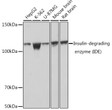


Anti-IDE antibody (1-100) [S7MR] (STJ11101287)
SPECIFICATIONS
ClonalityMonoclonal
HostRabbit
ConjugationUnconjugated
IsotypeIgG
General Information
| Short Description | Rabbit monoclonal IDE (1-100) antibody for use in WB and ELISA in human, mouse and rat samples. Datasheet included with dilution recommendations, and related reagents. |
| Applications | WB/ELISA |
| Host | Rabbit |
| Reactivity | Human/Mouse/Rat |
| Note | STRICTLY FOR FURTHER SCIENTIFIC RESEARCH USE ONLY (RUO). MUST NOT TO BE USED IN DIAGNOSTIC OR THERAPEUTIC APPLICATIONS. |
Product Properties
| Clonality | Monoclonal |
| Clone ID | S7MR |
| Isotype | IgG |
| Conjugation | Unconjugated |
| Concentration | Lot specific |
| Purification | Affinity purification |
| Dilution Range | WB:1:1000-1:6000ELISA:Recommended starting concentration is 1 Mu g/mL. Please optimize the concentration based on your specific assay requirements. |
| Formulation | PBS with 0.02% Sodium Azide, 0.05% BSA, 50% Glycerol, pH 7.3. |
| Storage Instruction | Store at-20°C for up to 1 year from the date of receipt, and avoid repeat freeze-thaw cycles. |
Target Information
| Gene Symbol | IDE |
| Gene ID | 3416 |
| Uniprot ID | IDE_HUMAN |
| Immunogen Region | 1-100 |
| Immunogen Sequence | MRYRLAWLLHPALPSTFRSV LGARLPPPERLCGFQKKTYS KMNNPAIKRIGNHITKSPED KREYRGLELANGIKVLLISD PTTDKSSAALDVHIGSLSDP |
| Specificity | A synthetic peptide corresponding to a sequence within amino acids 1-100 of human Insulin-degrading enzyme (IDE) (P14735). |
Additional Info
| Tissue Specificity | Detected in brain and in cerebrospinal fluid (at protein level). |
| Post Translational Modifications | The N-terminus is blocked. |
| Function | Plays a role in the cellular breakdown of insulin, APP peptides, IAPP peptides, natriuretic peptides, glucagon, bradykinin, kallidin, and other peptides, and thereby plays a role in intercellular peptide signaling. Substrate binding induces important conformation changes, making it possible to bind and degrade larger substrates, such as insulin. Contributes to the regulation of peptide hormone signaling cascades and regulation of blood glucose homeostasis via its role in the degradation of insulin, glucagon and IAPP. Plays a role in the degradation and clearance of APP-derived amyloidogenic peptides that are secreted by neurons and microglia (Probable). Degrades the natriuretic peptides ANP, BNP and CNP, inactivating their ability to raise intracellular cGMP. Also degrades an aberrant frameshifted 40-residue form of NPPA (fsNPPA) which is associated with familial atrial fibrillation in heterozygous patients. Involved in antigen processing. Produces both the N terminus and the C terminus of MAGEA3-derived antigenic peptide (EVDPIGHLY) that is presented to cytotoxic T lymphocytes by MHC class I. (Microbial infection) The membrane-associated isoform acts as an entry receptor for varicella-zoster virus (VZV). |
| Protein Name | Insulin-Degrading EnzymeAbeta-Degrading ProteaseInsulin ProteaseInsulinaseInsulysin |
| Database Links | Reactome: R-HSA-5689880Reactome: R-HSA-77387Reactome: R-HSA-9033241 |
| Cellular Localisation | CytoplasmCytosolCell MembraneSecretedPresent At The Cell Surface Of Neuron CellsThe Membrane-Associated Isoform Is Approximately 5 Kda Larger Than The Known Cytosolic Isoform |
| Alternative Antibody Names | Anti-Insulin-Degrading Enzyme antibodyAnti-Abeta-Degrading Protease antibodyAnti-Insulin Protease antibodyAnti-Insulinase antibodyAnti-Insulysin antibodyAnti-IDE antibody |
Information sourced from Uniprot.org