

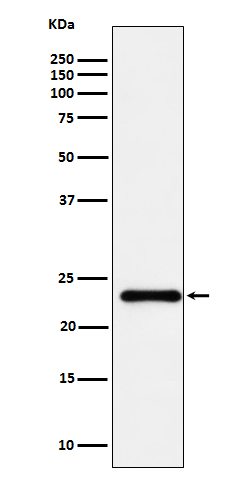

Anti-HSPC150 antibody [R53-8D-3] (STJA0035633)
SPECIFICATIONS
ClonalityMonoclonal
HostRabbit
ConjugationUnconjugated
IsotypeIgG
ImmunogenA synthesized peptide derived from human HSPC150
General Information
| Short Description | Rabbit monoclonal anti-HSPC150 for use in WB in Human samples. Datasheet included with dilution recommendations, and related reagents. |
| Applications | WB |
| Host | Rabbit |
| Reactivity | Human |
| Note | STRICTLY FOR FURTHER SCIENTIFIC RESEARCH USE ONLY (RUO). MUST NOT TO BE USED IN DIAGNOSTIC OR THERAPEUTIC APPLICATIONS. |
Product Properties
| Clonality | Monoclonal |
| Clone ID | R53-8D-3 |
| Isotype | IgG |
| Conjugation | Unconjugated |
| Purification | Affinity Chromatography |
| Dilution Range | WB 1:500-1:1000 |
| Formulation | Liquid in PBS, pH 7.4, 150mM NaCl, 0.02% sodium azide and 50% glycerol. |
| Storage Instruction | Store at 4°C short term. Aliquot and store at-20°C long term. Avoid freeze/thaw cycles. |
Target Information
| Gene Symbol | UBE2T |
| Gene ID | 29089 |
| Uniprot ID | UBE2T_HUMAN |
| Immunogen | A synthesized peptide derived from human HSPC150 |
Additional Info
| Post Translational Modifications | Auto-ubiquitinated. Effects of auto-monoubiquitination at Lys-91 and Lys-182 are unclear: according to a report, monoubiquitination inactivates E2 enzyme activity. In contrast, according to another report, autoubiquitination does not affect E2 enzyme activity. |
| Function | Accepts ubiquitin from the E1 complex and catalyzes its covalent attachment to other proteins. Catalyzes monoubiquitination. Involved in mitomycin-C (MMC)-induced DNA repair. Acts as a specific E2 ubiquitin-conjugating enzyme for the Fanconi anemia complex by associating with E3 ubiquitin-protein ligase FANCL and catalyzing monoubiquitination of FANCD2, a key step in the DNA damage pathway. Also mediates monoubiquitination of FANCL and FANCI. May contribute to ubiquitination and degradation of BRCA1. In vitro able to promote polyubiquitination using all 7 ubiquitin Lys residues, but may prefer 'Lys-11'-, 'Lys-27'-, 'Lys-48'- and 'Lys-63'-linked polyubiquitination. |
| Protein Name | Ubiquitin-Conjugating Enzyme E2 TCell Proliferation-Inducing Gene 50 ProteinE2 Ubiquitin-Conjugating Enzyme TUbiquitin Carrier Protein TUbiquitin-Protein Ligase T |
| Database Links | Reactome: R-HSA-6783310Reactome: R-HSA-8866652 |
| Cellular Localisation | NucleusAccumulates To Chromatin |
| Alternative Antibody Names | Anti-Ubiquitin-Conjugating Enzyme E2 T antibodyAnti-Cell Proliferation-Inducing Gene 50 Protein antibodyAnti-E2 Ubiquitin-Conjugating Enzyme T antibodyAnti-Ubiquitin Carrier Protein T antibodyAnti-Ubiquitin-Protein Ligase T antibodyAnti-UBE2T antibodyAnti-HSPC150 antibodyAnti-PIG50 antibody |
Information sourced from Uniprot.org