


Anti-HPV11 E6 antibody (65aa to N-terminal) (STJ140041)
SPECIFICATIONS
ClonalityPolyclonal
HostGoat
ConjugationUnconjugated
IsotypeIgG
ImmunogenPurified recombinant peptide derived from within residues 65 aa to N-terminal of HPV11 E6 produced in E. coli.
General Information
| Short Description | Goat polyclonal HPV11 E6 (65aa to N-terminal) antibody for use in WB in hpv11 samples. Datasheet included with dilution recommendations, and related reagents. |
| Applications | WB |
| Host | Goat |
| Reactivity | HPV11 |
| Note | STRICTLY FOR FURTHER SCIENTIFIC RESEARCH USE ONLY (RUO). MUST NOT TO BE USED IN DIAGNOSTIC OR THERAPEUTIC APPLICATIONS. |
Product Properties
| Clonality | Polyclonal |
| Isotype | IgG |
| Conjugation | Unconjugated |
| Concentration | 3 mg/mL |
| Purification | This antibody is epitope-affinity purified from goat antiserum. |
| Dilution Range | WB 1:500-1:2000 |
| Formulation | PBS, 20% Glycerol and 0.05% Sodium Azide. |
| Storage Instruction | For continuous use, store at 2-8 C for one-two days. For extended storage, store in-20 C freezer. Working dilution samples should be discarded if not used within 12 hours. |
Target Information
| Immunogen | Purified recombinant peptide derived from within residues 65 aa to N-terminal of HPV11 E6 produced in E. coli. |
| Immunogen Region | 65aa to N-terminal |
| Immunogen Sequence | MESKDASTSATSIDQLCKTF ESKDASTSATSIDQLCKTFN SKDASTSATSIDQLCKTFNL KDASTSATSIDQLCKTFNLS |
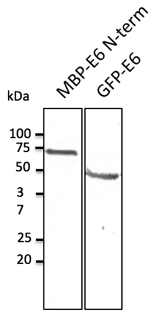
| Specificity | Detects HPV11 E6 recombinant fusion proteins MBP-E6 and GFP-E6 expressed in transfected mammalian cells. |
Additional Info
| Background | Goat polyclonal antibody to HPV11 E6. E6 is one primary oncoprotein of high risk HPV types expressed early in the HPV life cycle. After the host cell is infected viral early promoter is activated and a polycistronic primary RNA containing all six early ORFs is transcribed. This polycistronic RNA then undergoes active RNA splicing to generate multiple isoforms of mRNAs. One of the spliced isoform RNAs, E6, serves as an E7 mRNA to translate E7 protein. HPV genome integrate into host genome by disruption of E2 ORF, preventing E2 repression on E6 and E7. Thus, viral genome integration into host DNA genome increases E6 expression. The E6 protein inactivates the tumour suppressor protein, p53 and promote cellular proliferation and the chance of malignancy. |
Information sourced from Uniprot.org