

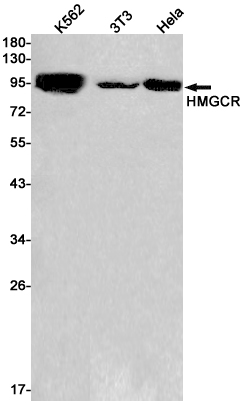

Anti-HMGCR antibody [R04-2J3] (STJA0034423)
SPECIFICATIONS
ClonalityMonoclonal
HostRabbit
ConjugationUnconjugated
IsotypeIgG
ImmunogenA synthetic peptide of human HMGCR
General Information
| Short Description | Rabbit monoclonal anti-HMGCR for use in WB and IP in Human and Mouse samples. Datasheet included with dilution recommendations, and related reagents. |
| Applications | WB/IP |
| Host | Rabbit |
| Reactivity | Human/Mouse |
| Note | STRICTLY FOR FURTHER SCIENTIFIC RESEARCH USE ONLY (RUO). MUST NOT TO BE USED IN DIAGNOSTIC OR THERAPEUTIC APPLICATIONS. |
Product Properties
| Clonality | Monoclonal |
| Clone ID | R04-2J3 |
| Isotype | IgG |
| Conjugation | Unconjugated |
| Concentration | 0.3 mg/mL |
| Purification | Affinity Purified |
| Dilution Range | WB 1:500-1:1000IP 1:20 |
| Formulation | 50mM Tris-Glycine (pH 7.4) , 0.15M NaCl, 40% Glycerol, 0.01% Sodium azide and 0.05% BSA |
| Storage Instruction | Store at 4°C short term. Aliquot and store at-20°C long term. Avoid freeze/thaw cycles. |
Target Information
| Gene Symbol | HMGCR |
| Gene ID | 3156 |
| Uniprot ID | HMDH_HUMAN |
| Immunogen | A synthetic peptide of human HMGCR |
Additional Info
| Tissue Specificity | Isoform 1: Ubiquitously expressed with the highest levels in the cerebellum, fetal brain, testis, skin and adrenal gland. Isoform 2: Detected in the cerebellum, fetal brain, testis and adrenal gland. Isoform 3: Low abundance except in skin, esophagus, and uterine cervix. |
| Post Translational Modifications | N-glycosylated. Deglycosylated by NGLY1 on release from the endoplasmic reticulum (ER) in a sterol-mediated manner. Undergoes sterol-mediated ubiquitination and ER-associated degradation (ERAD). Accumulation of sterols in the endoplasmic reticulum (ER) membrane, triggers binding of the reductase to the ER membrane protein INSIG1 or INSIG2. The INSIG1 binding leads to the recruitment of the ubiquitin ligase, AMFR/gp78, RNF139 or RNF145, initiating ubiquitination of the reductase. The ubiquitinated reductase is then extracted from the ER membrane and delivered to cytosolic 26S proteosomes by a mechanism probably mediated by the ATPase Valosin-containing protein VCP/p97. The INSIG2-binding leads to the recruitment of the ubiquitin ligase RNF139, initiating ubiquitination of the reductase. Lys-248 is the main site of ubiquitination. Ubiquitination is enhanced by the presence of a geranylgeranylated protein. Phosphorylated. Phosphorylation at Ser-872 reduces the catalytic activity. |
| Function | Catalyzes the conversion of (3S)-hydroxy-3-methylglutaryl-CoA (HMG-CoA) to mevalonic acid, the rate-limiting step in the synthesis of cholesterol and other isoprenoids, thus plays a critical role in cellular cholesterol homeostasis. HMGCR is the main target of statins, a class of cholesterol-lowering drugs. |
| Protein Name | 3-Hydroxy-3-Methylglutaryl-Coenzyme A ReductaseHmg-Coa Reductase |
| Database Links | Reactome: R-HSA-191273Reactome: R-HSA-1989781 P04035-1Reactome: R-HSA-2426168 P04035-1Reactome: R-HSA-9619665 |
| Cellular Localisation | Endoplasmic Reticulum MembraneMulti-Pass Membrane ProteinPeroxisome Membrane |
| Alternative Antibody Names | Anti-3-Hydroxy-3-Methylglutaryl-Coenzyme A Reductase antibodyAnti-Hmg-Coa Reductase antibodyAnti-HMGCR antibody |
Information sourced from Uniprot.org