


Anti-GPCR GPR3 antibody (5-50) (STJ501253)
SPECIFICATIONS
ClonalityPolyclonal
HostRabbit
ConjugationUnconjugated
IsotypeIgG
ImmunogenSynthetic peptide taken within amino acid region 5-50 on rat GPCR3 protein.
General Information
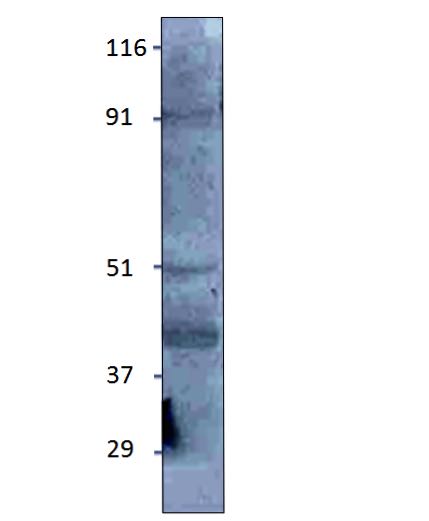
| Short Description | Rabbit polyclonal antibody anti-GPCR GPR3 (5-50) is suitable for use in ELISA and Western Blot research applications. |
| Applications | ELISA/WB |
| Host | Rabbit |
| Reactivity | Mouse/Rat |
| Note | STRICTLY FOR FURTHER SCIENTIFIC RESEARCH USE ONLY (RUO). MUST NOT TO BE USED IN DIAGNOSTIC OR THERAPEUTIC APPLICATIONS. |
Product Properties
| Clonality | Polyclonal |
| Isotype | IgG |
| Conjugation | Unconjugated |
| Concentration | 0.65 µg/µl |
| Purification | Affinity Purified |
| Dilution Range | WB: 1:500-1:750DB: 1:20, 000-1:50, 000ELISA: 1:20, 000-1:50, 000 |
| Formulation | Contains Tris, HCl/Glycine buffer pH 7.4-7.8, 30% Glycerol and 0.5% BSA, along with cryo-protective agents, Hepes, and long-term preservatives (0.02% Sodium Azide). |
| Storage Instruction | Store at-20°C for long term storage. Avoid freeze-thaw cycles. |
Target Information
| Gene Symbol | Gpr3 |
| Gene ID | 266769 |
| Uniprot ID | GPR3_RAT |
| Immunogen | Synthetic peptide taken within amino acid region 5-50 on rat GPCR3 protein. |
| Immunogen Region | 5-50 |
Additional Info
| Tissue Specificity | Abundantly expressed in granule neurons at all development stages. Enriched in the longest tips of neurites during differentiation of hippocampal neurons. |
| Function | Constitutively active G-protein coupled receptor that maintains high 3'-5'-cyclic adenosine monophosphate (cAMP) levels that a plays a role in serveral processes including meiotic arrest in oocytes or neuronal development via activation of numerous intracellular signaling pathways. Acts as an essential activator of thermogenic adipocytes and drives thermogenesis via its intrinsic G(s)-coupling activity without the requirement of a ligand. Has a potential role in modulating a number of brain functions, including behavioral responses to stress, amyloid-beta peptide generation in neurons. Stimulates neurite outgrowth in cerebellar granular neurons modulated via PKA, ERK, and most strongly PI3K-mediated signaling pathways. |
| Protein Name | G-Protein Coupled Receptor 3G-Protein-Coupled Receptor R4 |
| Cellular Localisation | Cell MembraneMulti-Pass Membrane Protein |
| Alternative Antibody Names | Anti-G-Protein Coupled Receptor 3 antibodyAnti-G-Protein-Coupled Receptor R4 antibodyAnti-Gpr3 antibody |
Information sourced from Uniprot.org