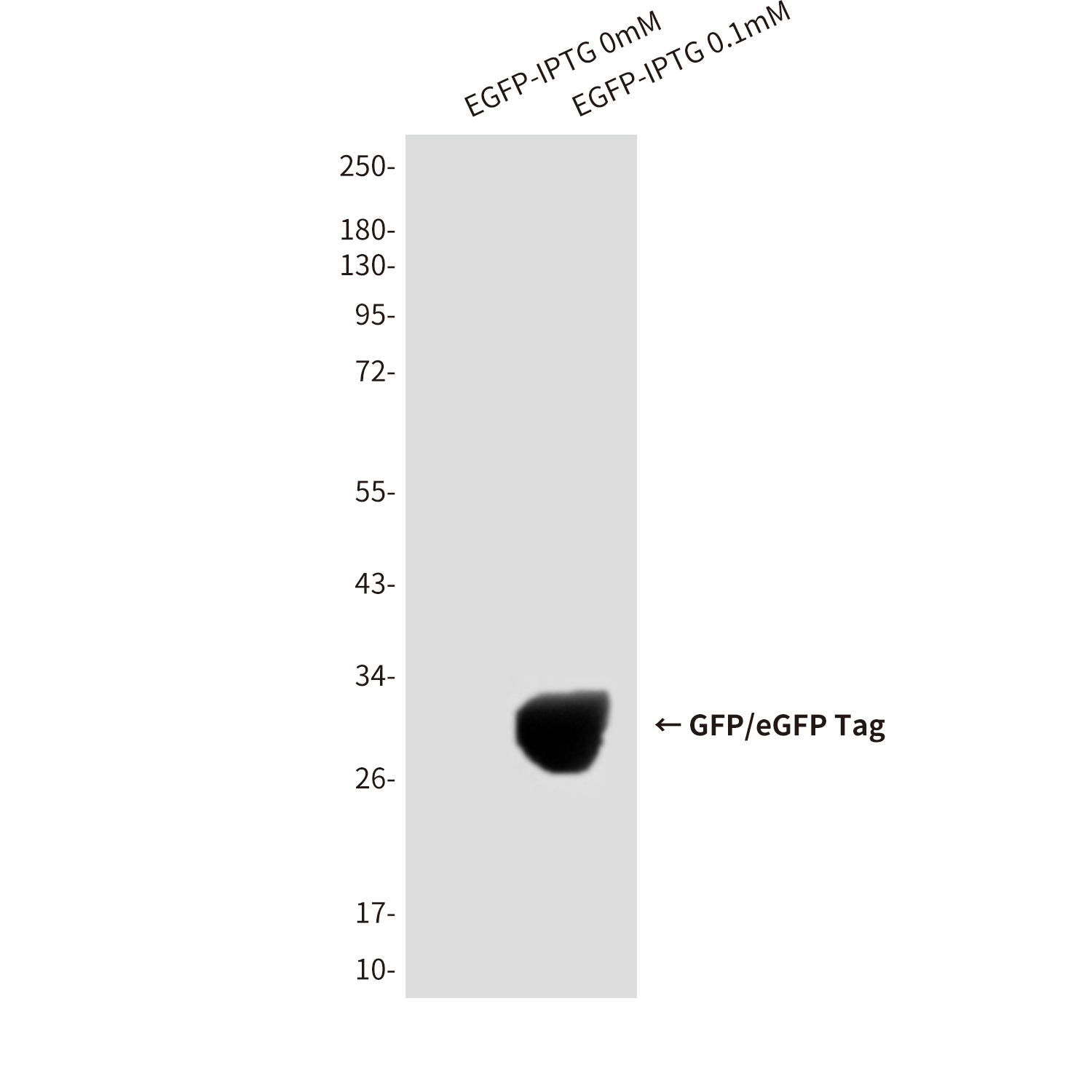
| Short Description : | Mouse monoclonal anti-GFP/eGFP-Tag for use in WB in Species-independent samples. Datasheet included with dilution recommendations, and related reagents. |
| Applications: | WB |
| Host: | Mouse |
| Reactivity: | Species-independent |
| Note: | STRICTLY FOR FURTHER SCIENTIFIC RESEARCH USE ONLY (RUO). MUST NOT TO BE USED IN DIAGNOSTIC OR THERAPEUTIC APPLICATIONS. |
| Clonality : | Monoclonal |
| Clone ID : | 3F11-B12-E7-F12 |
| Isotype: | IgG1 |
| Conjugation: | Unconjugated |
| Concentration: | 2.28 mg/mL |
| Purification: | Affinity Purified |
| Dilution Range: | WB 1:1000-1:10000 |
| Formulation: | Liquid in PBS containing 50% glycerol, 0.5% BSA and 0.02% sodium azide, pH 7.3. |
| Storage Instruction: | Store at 4°C short term. Aliquot and store at-20°C long term. Avoid freeze/thaw cycles. |
| Immunogen: | Purified recombinant EYFP.tag full length expressed in E.coli. |
| Background | Swiss-Prot Acc.C8CHS1.Epitope tags are useful for the labeling and detection of proteins using immunoblotting, immunoprecipitation, and immunostaining techniques. Because of their small size, they are unlikely to affect the tagged protein s biochemical properties.The green-fluorescent protein (GFP) functions as a bioluminescence energy transfer acceptor in the jellyfish Aequorea that maximally absorbs light at 395 nm and has an emission spectrum that peaks at 509 nm. GFP has become a very useful tool as a fusion protein that reports gene expression, traces cell lineage and defines subcellular protein localization. |
Information sourced from Uniprot.org