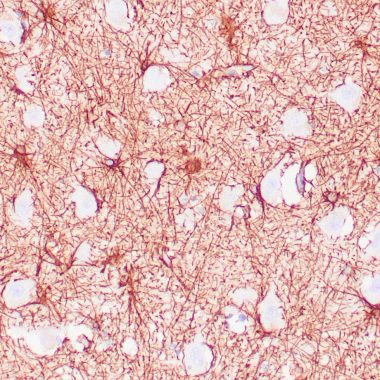
| Host: | Mouse |
| Applications: | IHC-P |
| Reactivity: | Human |
| Note: | STRICTLY FOR FURTHER SCIENTIFIC RESEARCH USE ONLY (RUO). MUST NOT TO BE USED IN DIAGNOSTIC OR THERAPEUTIC APPLICATIONS. |
| Short Description : | Mouse monoclonal GFAP antibody for use in IHC-P in human samples. Datasheet included with dilution recommendations, and related reagents. |
| Clonality : | Monoclonal |
| Clone ID : | GA‐5 |
| Conjugation: | Unconjugated |
| Isotype: | IgG1k |
| Formulation: | Tris-HCI buffer containing stabilizing protein (BSA) and <0.1% ProClin |
| Purification: | Affinity purified |
| Dilution Range: | 1:100‐200 |
| Storage Instruction: | Store at 2‐8°C for up to 24 months. Predilute: Ready to use, no reconstitution necessary. Concentrate: Use dilution range and appropriate lab‐standardized diluent. Stability after dilution: 7 days at 24°C, 3 months at 2‐8°C, 6months at ‐20°C. |
| Gene Symbol: | GFAP |
| Gene ID: | 2670 |
| Uniprot ID: | GFAP_HUMAN |
| Specificity: | Positive control: Brain or astrocytoma |
| Immunogen: | Native GFAP purified from pig spinal cord |
| Tissue Specificity | Expressed in cells lacking fibronectin. |
| Post Translational Modifications | Phosphorylated by PKN1. |
| Function | GFAP, a class-III intermediate filament, is a cell-specific marker that, during the development of the central nervous system, distinguishes astrocytes from other glial cells. |
| Protein Name | Glial Fibrillary Acidic ProteinGfap |
| Database Links | Reactome: R-HSA-1251985Reactome: R-HSA-9613829 |
| Cellular Localisation | CytoplasmAssociated With Intermediate Filaments |
| Alternative Antibody Names | Anti-Glial Fibrillary Acidic Protein antibodyAnti-Gfap antibodyAnti-GFAP antibody |
Information sourced from Uniprot.org


![Anti-GFAP antibody [SM5031] (STJA0005031)](https://cdn11.bigcommerce.com/s-zso2xnchw9/images/stencil/600x533/products/180091/403359/STJA0005031_1__93733.1738950426.png?c=1 "Anti-GFAP antibody [SM5031] (STJA0005031)")