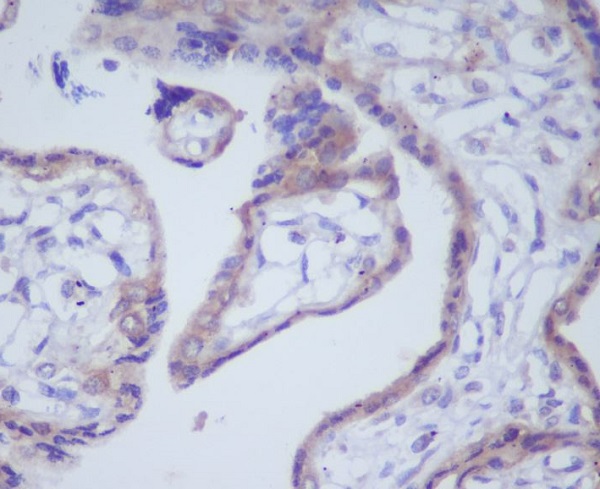
| Tissue Specificity | Placenta. |
| Function | Antagonizes canonical Wnt signaling by inhibiting LRP5/6 interaction with Wnt and by forming a ternary complex with the transmembrane protein KREMEN that promotes internalization of LRP5/6. DKKs play an important role in vertebrate development, where they locally inhibit Wnt regulated processes such as antero-posterior axial patterning, limb development, somitogenesis and eye formation. In the adult, Dkks are implicated in bone formation and bone disease, cancer and Alzheimer disease. Inhibits the pro-apoptotic function of KREMEN1 in a Wnt-independent manner, and has anti-apoptotic activity. |
| Protein Name | Dickkopf-Related Protein 1Dickkopf-1Dkk-1Hdkk-1Sk |
| Database Links | Reactome: R-HSA-201681Reactome: R-HSA-3772470Reactome: R-HSA-5339717 |
| Cellular Localisation | Secreted |
| Alternative Antibody Names | Anti-Dickkopf-Related Protein 1 antibodyAnti-Dickkopf-1 antibodyAnti-Dkk-1 antibodyAnti-Hdkk-1 antibodyAnti-Sk antibodyAnti-DKK1 antibodyAnti-UNQ492 antibodyAnti-PRO1008 antibody |
Information sourced from Uniprot.org