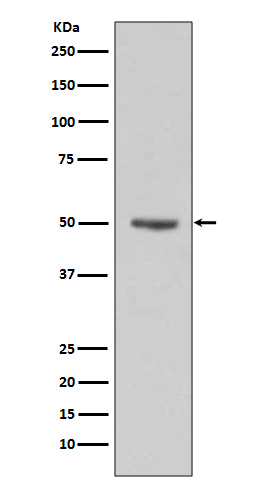
| Short Description : | Rabbit monoclonal anti-Cyclin E1 for use in WB, ICC, IF, IP and FC in Human samples. Datasheet included with dilution recommendations, and related reagents. |
| Applications: | WB/ICC/IF/IP/FC |
| Host: | Rabbit |
| Reactivity: | Human |
| Note: | STRICTLY FOR FURTHER SCIENTIFIC RESEARCH USE ONLY (RUO). MUST NOT TO BE USED IN DIAGNOSTIC OR THERAPEUTIC APPLICATIONS. |
| Clonality : | Monoclonal |
| Clone ID : | R04-9F1 |
| Isotype: | IgG |
| Conjugation: | Unconjugated |
| Purification: | Affinity Chromatography |
| Dilution Range: | WB 1:500-1:1000IF 1:50-1:200IP 1:50FC 1:50-1:100 |
| Formulation: | Rabbit IgG in phosphate buffered saline, pH 7.4, 150mM NaCl, 0.02% sodium azide and 50% glycerol. |
| Storage Instruction: | Store at 4°C short term. Aliquot and store at-20°C long term. Avoid freeze/thaw cycles. |
| Gene Symbol: | CCNE1 |
| Gene ID: | 898 |
| Uniprot ID: | CCNE1_HUMAN |
| Immunogen: | A synthesized peptide derived from human Cyclin E1 |
| Tissue Specificity | Highly expressed in testis and placenta. Low levels in bronchial epithelial cells. |
| Post Translational Modifications | Phosphorylation of both Thr-395 by GSK3 and Ser-399 by CDK2 creates a high affinity degron recognized by FBXW7, and accelerates degradation via the ubiquitin proteasome pathway. Phosphorylation at Thr-77 creates a low affinity degron also recognized by FBXW7. Ubiquitinated by UHRF2.appears to occur independently of phosphorylation. |
| Function | Essential for the control of the cell cycle at the G1/S (start) transition. |
| Protein Name | G1/S-Specific Cyclin-E1 |
| Database Links | Reactome: R-HSA-1538133Reactome: R-HSA-187577Reactome: R-HSA-2559586Reactome: R-HSA-390471Reactome: R-HSA-6804116Reactome: R-HSA-69017Reactome: R-HSA-69200Reactome: R-HSA-69202Reactome: R-HSA-69205Reactome: R-HSA-69231Reactome: R-HSA-69563Reactome: R-HSA-8849470Reactome: R-HSA-9661069Reactome: R-HSA-9706019 |
| Cellular Localisation | Nucleus |
| Alternative Antibody Names | Anti-G1/S-Specific Cyclin-E1 antibodyAnti-CCNE1 antibodyAnti-CCNE antibody |
Information sourced from Uniprot.org