| Tissue Specificity | Isoform 1 is expressed in immature oocytes, ovary, brain and heart. Isoform 2 is expressed in brain and heart. Isoform 3 and isoform 4 are expressed in brain. Expressed in breast tumors and several tumor cell lines. |
| Post Translational Modifications | Phosphorylated on serine/threonine residues by AURKA within positions 166 and 197. Phosphorylation and dephosphorylation on Thr-172 regulates cytoplasmic polyadenylation and translation of CPE-containing mRNAs. Phosphorylation on Thr-172 by AURKA and CAMK2A activates CPEB1. Phosphorylation on Thr-172 may be promoted by APLP1. Phosphorylation increases binding to RNA. |
| Function | Sequence-specific RNA-binding protein that regulates mRNA cytoplasmic polyadenylation and translation initiation during oocyte maturation, early development and at postsynapse sites of neurons. Binds to the cytoplasmic polyadenylation element (CPE), an uridine-rich sequence element (consensus sequence 5'-UUUUUAU-3') within the mRNA 3'-UTR. RNA binding results in a clear conformational change analogous to the Venus fly trap mechanism. In absence of phosphorylation and in association with TACC3 is also involved as a repressor of translation of CPE-containing mRNA.a repression that is relieved by phosphorylation or degradation. Involved in the transport of CPE-containing mRNA to dendrites.those mRNAs may be transported to dendrites in a translationally dormant form and translationally activated at synapses. Its interaction with APLP1 promotes local CPE-containing mRNA polyadenylation and translation activation. Induces the assembly of stress granules in the absence of stress. Required for cell cycle progression, specifically for prophase entry. |
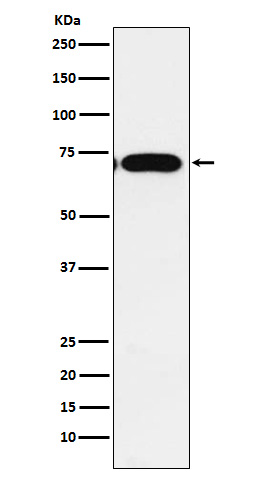
| Protein Name | Cytoplasmic Polyadenylation Element-Binding Protein 1Cpe-Bp1Cpe-Binding Protein 1H-CpebHcpeb-1 |
| Database Links | |
| Cellular Localisation | CytoplasmNucleusP-BodyCytoplasmic GranuleSynapseMembranePostsynaptic DensityCell ProjectionDendriteContinuously Shuttling Between Nucleus And CytoplasmAlso Found In Stress GranulesRecruited To Stress Granules (Sgs) Upon Arsenite TreatmentIn DendritesLocalizes In Synaptosomes At Dendritic Synapses Of NeuronsStrongly Enriched In Postsynaptic Density (Psd) FractionsTransported Into Dendrites In A Microtubule-Dependent Fashion And Colocalizes In Mrna-Containing Particles With Tacc3Dynein And KinesinMembrane-AssociatedColocalizes At Excitatory Synapses With Members Of The Polyadenylation And Translation Complex Factors (CpsfAplp1Tacc3AurkaSypEtc) Including Cpe-Containing Rnas |
| Alternative Antibody Names | Anti-Cytoplasmic Polyadenylation Element-Binding Protein 1 antibodyAnti-Cpe-Bp1 antibodyAnti-Cpe-Binding Protein 1 antibodyAnti-H-Cpeb antibodyAnti-Hcpeb-1 antibodyAnti-CPEB1 antibodyAnti-CPEB antibody |
Information sourced from Uniprot.org