

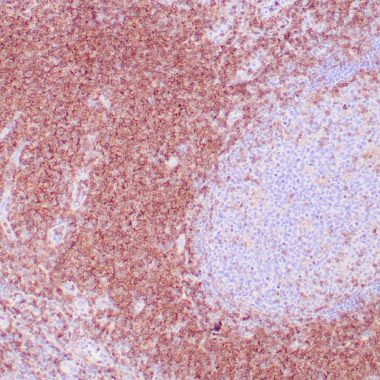

Anti-CD4 antibody (216-396aa) [ZM180] (STJ180495)
SPECIFICATIONS
ClonalityMonoclonal
HostMouse
ConjugationUnconjugated
IsotypeIgG2ak
ImmunogenRecombinant fragment (around aa 216-396) of human CD4 protein
General Information
| Short Description | Mouse monoclonal CD4 (216-396aa) antibody for use in IHC-P in human samples. Datasheet included with dilution recommendations, and related reagents. |
| Applications | IHC-P |
| Host | Mouse |
| Reactivity | Human |
| Note | STRICTLY FOR FURTHER SCIENTIFIC RESEARCH USE ONLY (RUO). MUST NOT TO BE USED IN DIAGNOSTIC OR THERAPEUTIC APPLICATIONS. |
Product Properties
| Clonality | Monoclonal |
| Clone ID | ZM180 |
| Isotype | IgG2ak |
| Conjugation | Unconjugated |
| Purification | Affinity purified |
| Dilution Range | 1:100-200 |
| Formulation | Tris-HCI buffer containing stabilizing protein (BSA) and <0.1% ProClin |
| Storage Instruction | Store at 2‐8°C for up to 24 months. Predilute: Ready to use, no reconstitution necessary. Concentrate: Use dilution range and appropriate lab‐standardized diluent. Stability after dilution: 7 days at 24°C, 3 months at 2‐8°C, 6months at ‐20°C. |
Target Information
| Gene Symbol | CD4 |
| Gene ID | 920 |
| Uniprot ID | CD4_HUMAN |
| Immunogen | Recombinant fragment (around aa 216-396) of human CD4 protein |
| Immunogen Region | 216-396aa |
| Specificity | Positive control: Tonsil |
Additional Info
| Tissue Specificity | Highly expressed in T-helper cells. The presence of CD4 is a hallmark of T-helper cells which are specialized in the activation and growth of cytotoxic T-cells, regulation of B cells, or activation of phagocytes. CD4 is also present in other immune cells such as macrophages, dendritic cells or NK cells. |
| Post Translational Modifications | Palmitoylation and association with LCK contribute to the enrichment of CD4 in lipid rafts. Phosphorylated by PKC.phosphorylation at Ser-433 plays an important role for CD4 internalization. |
| Function | Integral membrane glycoprotein that plays an essential role in the immune response and serves multiple functions in responses against both external and internal offenses. In T-cells, functions primarily as a coreceptor for MHC class II molecule:peptide complex. The antigens presented by class II peptides are derived from extracellular proteins while class I peptides are derived from cytosolic proteins. Interacts simultaneously with the T-cell receptor (TCR) and the MHC class II presented by antigen presenting cells (APCs). In turn, recruits the Src kinase LCK to the vicinity of the TCR-CD3 complex. LCK then initiates different intracellular signaling pathways by phosphorylating various substrates ultimately leading to lymphokine production, motility, adhesion and activation of T-helper cells. In other cells such as macrophages or NK cells, plays a role in differentiation/activation, cytokine expression and cell migration in a TCR/LCK-independent pathway. Participates in the development of T-helper cells in the thymus and triggers the differentiation of monocytes into functional mature macrophages. (Microbial infection) Primary receptor for human immunodeficiency virus-1 (HIV-1). Down-regulated by HIV-1 Vpu. Acts as a receptor for Human Herpes virus 7/HHV-7. |
| Protein Name | T-Cell Surface Glycoprotein Cd4T-Cell Surface Antigen T4/Leu-3Cd Antigen Cd4 |
| Database Links | Reactome: R-HSA-1462054Reactome: R-HSA-167590Reactome: R-HSA-173107Reactome: R-HSA-180534Reactome: R-HSA-202424Reactome: R-HSA-202427Reactome: R-HSA-202430Reactome: R-HSA-202433Reactome: R-HSA-389948Reactome: R-HSA-449836Reactome: R-HSA-8856825Reactome: R-HSA-8856828 |
| Cellular Localisation | Cell MembraneSingle-Pass Type I Membrane ProteinLocalizes To Lipid RaftsRemoved From Plasma Membrane By Hiv-1 Nef Protein That Increases Clathrin-Dependent Endocytosis Of This Antigen To Target It To Lysosomal DegradationCell Surface Expression Is Also Down-Modulated By Hiv-1 Envelope Polyprotein Gp160 That Interacts WithAnd Sequesters Cd4 In The Endoplasmic Reticulum |
| Alternative Antibody Names | Anti-T-Cell Surface Glycoprotein Cd4 antibodyAnti-T-Cell Surface Antigen T4/Leu-3 antibodyAnti-Cd Antigen Cd4 antibodyAnti-CD4 antibody |
Information sourced from Uniprot.org