

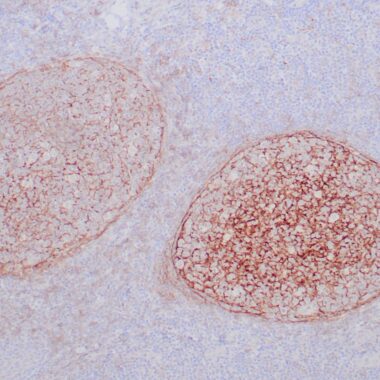

Anti-CD21 antibody (44-196) [ZR419] (STJ180633)
SPECIFICATIONS
ClonalityMonoclonal
HostRabbit
ConjugationUnconjugated
IsotypeIgG
ImmunogenRecombinant human CR2 (CD21) protein fragment (around aa 44-196)
General Information
| Short Description | Rabbit monoclonal CD21 (44-196) antibody for use in IHC-P in human samples. Datasheet included with dilution recommendations, and related reagents. |
| Applications | IHC-P |
| Host | Rabbit |
| Reactivity | Human |
| Note | STRICTLY FOR FURTHER SCIENTIFIC RESEARCH USE ONLY (RUO). MUST NOT TO BE USED IN DIAGNOSTIC OR THERAPEUTIC APPLICATIONS. |
Product Properties
| Clonality | Monoclonal |
| Clone ID | ZR419 |
| Isotype | IgG |
| Conjugation | Unconjugated |
| Purification | Affinity purified |
| Dilution Range | 1:100-200 |
| Formulation | Tris-HCI buffer containing stabilizing protein (BSA) and <0.1% ProClin |
| Storage Instruction | Store at 2‐8°C for up to 24 months. Predilute: Ready to use, no reconstitution necessary. Concentrate: Use dilution range and appropriate lab‐standardized diluent. Stability after dilution: 7 days at 24°C, 3 months at 2‐8°C, 6months at ‐20°C. |
Target Information
| Gene Symbol | CR2 |
| Gene ID | 1380 |
| Uniprot ID | CR2_HUMAN |
| Immunogen | Recombinant human CR2 (CD21) protein fragment (around aa 44-196) |
| Immunogen Region | 44-196 |
| Specificity | Positive Control: Tonsil, lymph node |
Additional Info
| Tissue Specificity | Mature B-lymphocytes, T-lymphocytes, pharyngeal epithelial cells, astrocytes and follicular dendritic cells of the spleen. |
| Function | Serves as a receptor for various ligands including complement component CD3d, HNRNPU OR IFNA1. When C3d is bound to antigens, attaches to C3d on B-cell surface and thereby facilitates the recognition and uptake of antigens by B-cells. This interaction enhances B-cell activation and subsequent immune responses. Forms a complex with several partners on the surface of B-cells including CD19, FCRL5 and CD81, to form the B-cell coreceptor complex that plays a crucial role in B-cell activation and signaling. Also induces specific intracellular signaling separately from the BCR and CD19 by activating the tyrosine kinase SRC, which then phosphorylates nucleolin/NCL and triggers AKT and GSK3 kinase activities in a SYK/CD19-independent manner. Acts as a ligand for CD23 (FcepsilonRII), a low-affinity receptor for IgE, which is expressed on B-cells and other immune cells, and thus participates in the regulation of IgE production. (Microbial infection) Acts as a receptor for Epstein-Barr virus. |
| Protein Name | Complement Receptor Type 2Cr2Complement C3d ReceptorEpstein-Barr Virus ReceptorEbv ReceptorCd Antigen Cd21 |
| Database Links | Reactome: R-HSA-977606 |
| Cellular Localisation | Cell MembraneSingle-Pass Type I Membrane Protein |
| Alternative Antibody Names | Anti-Complement Receptor Type 2 antibodyAnti-Cr2 antibodyAnti-Complement C3d Receptor antibodyAnti-Epstein-Barr Virus Receptor antibodyAnti-Ebv Receptor antibodyAnti-Cd Antigen Cd21 antibodyAnti-CR2 antibodyAnti-C3DR antibody |
Information sourced from Uniprot.org