

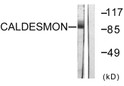


Anti-CALD1 antibody (744-793 aa) (STJ91973)
SPECIFICATIONS
ClonalityPolyclonal
HostRabbit
ConjugationUnconjugated
IsotypeIgG
ImmunogenThe antiserum was produced against synthesized peptide derived from the human Caldesmon at the amino acid range 744-793
General Information
| Short Description | Rabbit polyclonal anti-Caldesmon (744-793 aa) for use in WB, IHC, IF and ELISA in Human, Mouse and Rat samples. Datasheet included with dilution recommendations, and related reagents. |
| Applications | WB/IHC/IF/ELISA |
| Host | Rabbit |
| Reactivity | Human/Mouse/Rat |
| Note | STRICTLY FOR FURTHER SCIENTIFIC RESEARCH USE ONLY (RUO). MUST NOT TO BE USED IN DIAGNOSTIC OR THERAPEUTIC APPLICATIONS. |
Product Properties
| Clonality | Polyclonal |
| Isotype | IgG |
| Conjugation | Unconjugated |
| Concentration | 1 mg/mL |
| Purification | The antibody was affinity-purified from rabbit antiserum by affinity-chromatography using epitope-specific immunogen. |
| Dilution Range | WB 1:500-1:2000IHC 1:100-1:300IF 1:200-1:1000ELISA 1:5000 |
| Formulation | Liquid in PBS containing 50% Glycerol, 0.5% BSA and 0.02% Sodium Azide. |
| Storage Instruction | Store at-20°C for up to 1 year from the date of receipt, and avoid repeat freeze-thaw cycles. |
Target Information
| Gene Symbol | CALD1 |
| Gene ID | 800 |
| Uniprot ID | CALD1_HUMAN |
| Immunogen | The antiserum was produced against synthesized peptide derived from the human Caldesmon at the amino acid range 744-793 |
| Immunogen Region | 744-793 aa |
| Specificity | Caldesmon Polyclonal Antibody detects endogenous levels of Caldesmon protein. |
Additional Info
| Post Translational Modifications | In non-muscle cells, phosphorylation by CDK1 during mitosis causes caldesmon to dissociate from microfilaments. Phosphorylation reduces caldesmon binding to actin, myosin, and calmodulin as well as its inhibition of actomyosin ATPase activity. Phosphorylation also occurs in both quiescent and dividing smooth muscle cells with similar effects on the interaction with actin and calmodulin and on microfilaments reorganization. CDK1-mediated phosphorylation promotes Schwann cell migration during peripheral nerve regeneration. |
| Function | Actin- and myosin-binding protein implicated in the regulation of actomyosin interactions in smooth muscle and nonmuscle cells (could act as a bridge between myosin and actin filaments). Stimulates actin binding of tropomyosin which increases the stabilization of actin filament structure. In muscle tissues, inhibits the actomyosin ATPase by binding to F-actin. This inhibition is attenuated by calcium-calmodulin and is potentiated by tropomyosin. Interacts with actin, myosin, two molecules of tropomyosin and with calmodulin. Also plays an essential role during cellular mitosis and receptor capping. Involved in Schwann cell migration during peripheral nerve regeneration. |
| Protein Name | CaldesmonCdm |
| Database Links | Reactome: R-HSA-445355 |
| Cellular Localisation | CytoplasmCytoskeletonMyofibrilStress FiberOn Thin Filaments In Smooth Muscle And On Stress Fibers In Fibroblasts (Nonmuscle) |
| Alternative Antibody Names | Anti-Caldesmon antibodyAnti-Cdm antibodyAnti-CALD1 antibodyAnti-CAD antibodyAnti-CDM antibody |
Information sourced from Uniprot.org