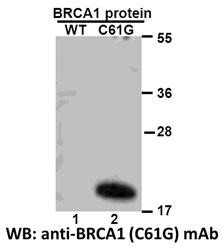
| Short Description : | Mouse monoclonal anti-BRCA1-C61G Mutant for use in WB, ICC, IF and ELISA in Vertebrates samples. Datasheet included with dilution recommendations, and related reagents. |
| Applications: | WB/ICC/IF/ELISA |
| Host: | Mouse |
| Reactivity: | Vertebrates |
| Note: | STRICTLY FOR FURTHER SCIENTIFIC RESEARCH USE ONLY (RUO). MUST NOT TO BE USED IN DIAGNOSTIC OR THERAPEUTIC APPLICATIONS. |
| Clonality : | Monoclonal |
| Isotype: | IgG |
| Conjugation: | Unconjugated |
| Purification: | Purified from ascites |
| Dilution Range: | WB-1:500-1:1000IHC-P-1:50-1:100ELISA-1:1000-1:2000IF-1:50-1:200 |
| Formulation: | Liquid in PBS (without Mg2+ and Ca2+) , pH 7.4, 150 mM NaCl, 50% glycerol |
| Storage Instruction: | Store at-20°C. Avoid freeze/thaw cycles. |
| Immunogen: | A synthetic peptide from the internal region of BRCA1 which includes the mutation of C61G, human origin. |
| Background | BRCA1 is normally expressed in cells of breast and other tissues, where it helps repair damaged DNA or destroy cells if DNA cannot be repaired. It is involved in the repair of chromosomal damage with an important role in the error-free repair of DNA double-strand breaks. If BRCA1 itself is damaged by a BRCA1 mutation, damaged DNA is not repaired properly, and this increases the risk for breast cancer. |
Information sourced from Uniprot.org