


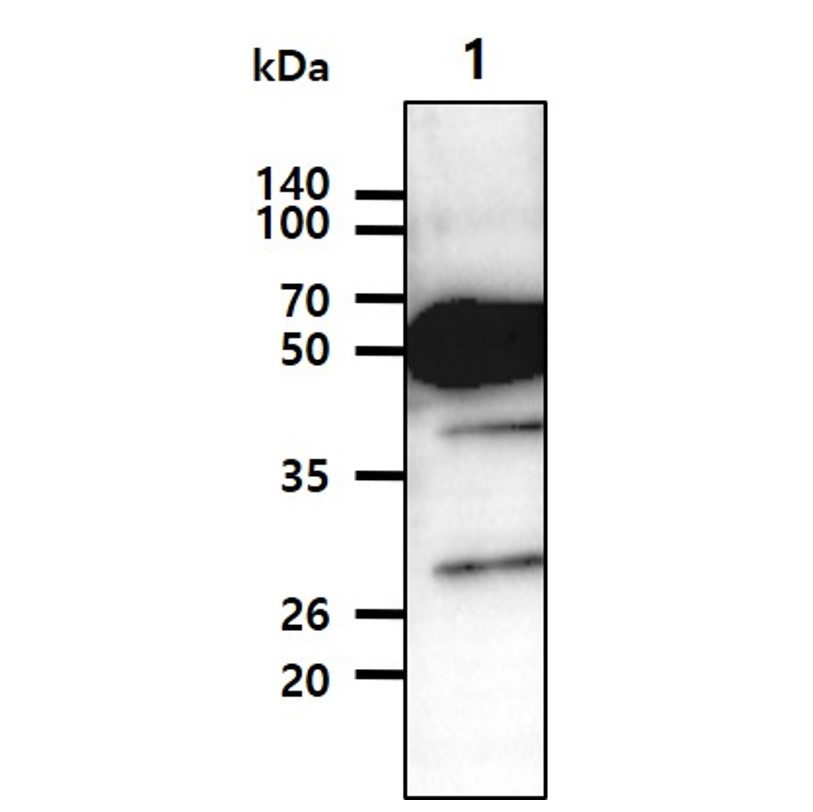


Anti-beta-II Tubulin antibody (1-445aa) [AT5B3] (STJA0041593)
SPECIFICATIONS
ClonalityMonoclonal
HostMouse
ConjugationUnconjugated
IsotypeIgG2ak
ImmunogenRecombinant human beta-Tubulin (1-445aa) purified from E. coli
General Information
| Short Description | Mouse monoclonal anti-beta-II Tubulin (1-445aa) for use in ELISA, WB and IHC in Human samples. Datasheet included with dilution recommendations, and related reagents. |
| Applications | ELISA/WB/IHC |
| Host | Mouse |
| Reactivity | Human |
| Note | STRICTLY FOR FURTHER SCIENTIFIC RESEARCH USE ONLY (RUO). MUST NOT TO BE USED IN DIAGNOSTIC OR THERAPEUTIC APPLICATIONS. |
Product Properties
| Clonality | Monoclonal |
| Clone ID | AT5B3 |
| Isotype | IgG2ak |
| Conjugation | Unconjugated |
| Concentration | 1 mg/mL |
| Purification | By protein-G affinity chromatography |
| Formulation | Liquid in phosphate-Buffered Saline (pH 7.4) with 0.02% Sodium Azide, 10% Glycerol |
| Storage Instruction | For short term storage, keep at +2C to +8C for up to 1 week. For long term storage, aliquot and store at-20C, and avoid repeat freeze-thaw cycles. |
Target Information
| Gene Symbol | TUBB2B |
| Gene ID | 347733 |
| Uniprot ID | TBB2B_HUMAN |
| Accession Number | NP_821080 |
| Immunogen | Recombinant human beta-Tubulin (1-445aa) purified from E. coli |
| Immunogen Region | 1-445aa |
Additional Info
| Tissue Specificity | High expression in brain. |
| Post Translational Modifications | Some glutamate residues at the C-terminus are polyglutamylated, resulting in polyglutamate chains on the gamma-carboxyl group. Polyglutamylation plays a key role in microtubule severing by spastin (SPAST). SPAST preferentially recognizes and acts on microtubules decorated with short polyglutamate tails: severing activity by SPAST increases as the number of glutamates per tubulin rises from one to eight, but decreases beyond this glutamylation threshold. Glutamylation is also involved in cilia motility. Some glutamate residues at the C-terminus are monoglycylated but not polyglycylated due to the absence of functional TTLL10 in human. Monoglycylation is mainly limited to tubulin incorporated into cilia and flagella axonemes, which is required for their stability and maintenance. Flagella glycylation controls sperm motility. Both polyglutamylation and monoglycylation can coexist on the same protein on adjacent residues, and lowering glycylation levels increases polyglutamylation, and reciprocally. Phosphorylated on Ser-172 by CDK1 during the cell cycle, from metaphase to telophase, but not in interphase. This phosphorylation inhibits tubulin incorporation into microtubules. |
| Function | Tubulin is the major constituent of microtubules, a cylinder consisting of laterally associated linear protofilaments composed of alpha- and beta-tubulin heterodimers. Microtubules grow by the addition of GTP-tubulin dimers to the microtubule end, where a stabilizing cap forms. Below the cap, tubulin dimers are in GDP-bound state, owing to GTPase activity of alpha-tubulin. Plays a critical role in proper axon guidance in both central and peripheral axon tracts. Implicated in neuronal migration. |
| Protein Name | Tubulin Beta-2b Chain |
| Database Links | Reactome: R-HSA-1445148Reactome: R-HSA-190840Reactome: R-HSA-190861Reactome: R-HSA-2132295Reactome: R-HSA-2467813Reactome: R-HSA-2500257Reactome: R-HSA-3371497Reactome: R-HSA-380320Reactome: R-HSA-389957Reactome: R-HSA-389960Reactome: R-HSA-389977Reactome: R-HSA-437239Reactome: R-HSA-5610787Reactome: R-HSA-5617833Reactome: R-HSA-5620924Reactome: R-HSA-5626467Reactome: R-HSA-5663220Reactome: R-HSA-6807878Reactome: R-HSA-6811434Reactome: R-HSA-6811436Reactome: R-HSA-68877Reactome: R-HSA-8852276Reactome: R-HSA-8955332Reactome: R-HSA-9609690Reactome: R-HSA-9609736Reactome: R-HSA-9619483Reactome: R-HSA-9646399Reactome: R-HSA-9648025Reactome: R-HSA-9668328Reactome: R-HSA-983189Reactome: R-HSA-9833482 |
| Cellular Localisation | CytoplasmCytoskeleton |
| Alternative Antibody Names | Anti-Tubulin Beta-2b Chain antibodyAnti-TUBB2B antibody |
Information sourced from Uniprot.org