
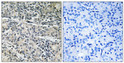


Anti-ATP5MJ antibody (9-58) (STJ94187)
SPECIFICATIONS
ClonalityPolyclonal
HostRabbit
ConjugationUnconjugated
IsotypeIgG
ImmunogenThe antiserum was produced against synthesized peptide derived from human MP68. AA range:9-58
General Information
| Short Description | Rabbit polyclonal anti-ATP synthase subunit ATP5MJ, mitochondrial (9-58) for use in IHC, IF and ELISA in Human and Mouse samples. Datasheet included with dilution recommendations, and related reagents. |
| Applications | IHC/IF/ELISA |
| Host | Rabbit |
| Reactivity | Human/Mouse |
| Note | STRICTLY FOR FURTHER SCIENTIFIC RESEARCH USE ONLY (RUO). MUST NOT TO BE USED IN DIAGNOSTIC OR THERAPEUTIC APPLICATIONS. |
Product Properties
| Clonality | Polyclonal |
| Isotype | IgG |
| Conjugation | Unconjugated |
| Concentration | 1 mg/mL |
| Purification | The antibody was affinity-purified from rabbit antiserum by affinity-chromatography using epitope-specific immunogen. |
| Dilution Range | IHC 1:100-1:300ELISA 1:20000IF 1:50-200 |
| Formulation | Liquid in PBS containing 50% Glycerol, 0.5% BSA and 0.02% Sodium Azide. |
| Storage Instruction | Store at-20°C for up to 1 year from the date of receipt, and avoid repeat freeze-thaw cycles. |
Target Information
| Gene Symbol | ATP5MJ |
| Gene ID | 9556 |
| Uniprot ID | ATP68_HUMAN |
| Immunogen | The antiserum was produced against synthesized peptide derived from human MP68. AA range:9-58 |
| Immunogen Region | 9-58 |
| Specificity | MP68 Polyclonal Antibody detects endogenous levels of MP68 protein. |
Additional Info
| Function | Subunit j, of the mitochondrial membrane ATP synthase complex (F(1)F(0) ATP synthase or Complex V) that produces ATP from ADP in the presence of a proton gradient across the membrane which is generated by electron transport complexes of the respiratory chain. ATP synthase complex consist of a soluble F(1) head domain - the catalytic core - and a membrane F(1) domain - the membrane proton channel. These two domains are linked by a central stalk rotating inside the F(1) region and a stationary peripheral stalk. During catalysis, ATP synthesis in the catalytic domain of F(1) is coupled via a rotary mechanism of the central stalk subunits to proton translocation (Probable). In vivo, can only synthesize ATP although its ATP hydrolase activity can be activated artificially in vitro. Part of the complex F(0) domain. Minor subunit required to maintain the ATP synthase population in the mitochondria. |
| Protein Name | Atp Synthase F(0 Complex Subunit J - Mitochondrial6.8 Kda Mitochondrial Proteolipid ProteinMlqAtp Synthase Membrane Subunit 6.8pl |
| Database Links | Reactome: R-HSA-163210Reactome: R-HSA-8949613 |
| Cellular Localisation | Mitochondrion MembraneSingle-Pass Membrane Protein |
| Alternative Antibody Names | Anti-Atp Synthase F(0 Complex Subunit J - Mitochondrial antibodyAnti-6.8 Kda Mitochondrial Proteolipid Protein antibodyAnti-Mlq antibodyAnti-Atp Synthase Membrane Subunit 6.8pl antibodyAnti-ATP5MJ antibodyAnti-ATP5MPL antibodyAnti-C14orf2 antibodyAnti-MP68 antibodyAnti-PRO1574 antibody |
Information sourced from Uniprot.org