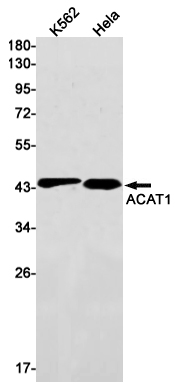
| Post Translational Modifications | Succinylation at Lys-268, adjacent to a coenzyme A binding site. Desuccinylated by SIRT5. |
| Function | This is one of the enzymes that catalyzes the last step of the mitochondrial beta-oxidation pathway, an aerobic process breaking down fatty acids into acetyl-CoA. Using free coenzyme A/CoA, catalyzes the thiolytic cleavage of medium- to long-chain 3-oxoacyl-CoAs into acetyl-CoA and a fatty acyl-CoA shortened by two carbon atoms. The activity of the enzyme is reversible and it can also catalyze the condensation of two acetyl-CoA molecules into acetoacetyl-CoA. Thereby, it plays a major role in ketone body metabolism. |
| Protein Name | Acetyl-Coa Acetyltransferase - MitochondrialAcetoacetyl-Coa ThiolaseT2 |
| Database Links | Reactome: R-HSA-70895Reactome: R-HSA-77108Reactome: R-HSA-77111Reactome: R-HSA-9837999Reactome: R-HSA-9854311Reactome: R-HSA-9915355 |
| Cellular Localisation | Mitochondrion |
| Alternative Antibody Names | Anti-Acetyl-Coa Acetyltransferase - Mitochondrial antibodyAnti-Acetoacetyl-Coa Thiolase antibodyAnti-T2 antibodyAnti-ACAT1 antibodyAnti-ACAT antibodyAnti-MAT antibody |
Information sourced from Uniprot.org