

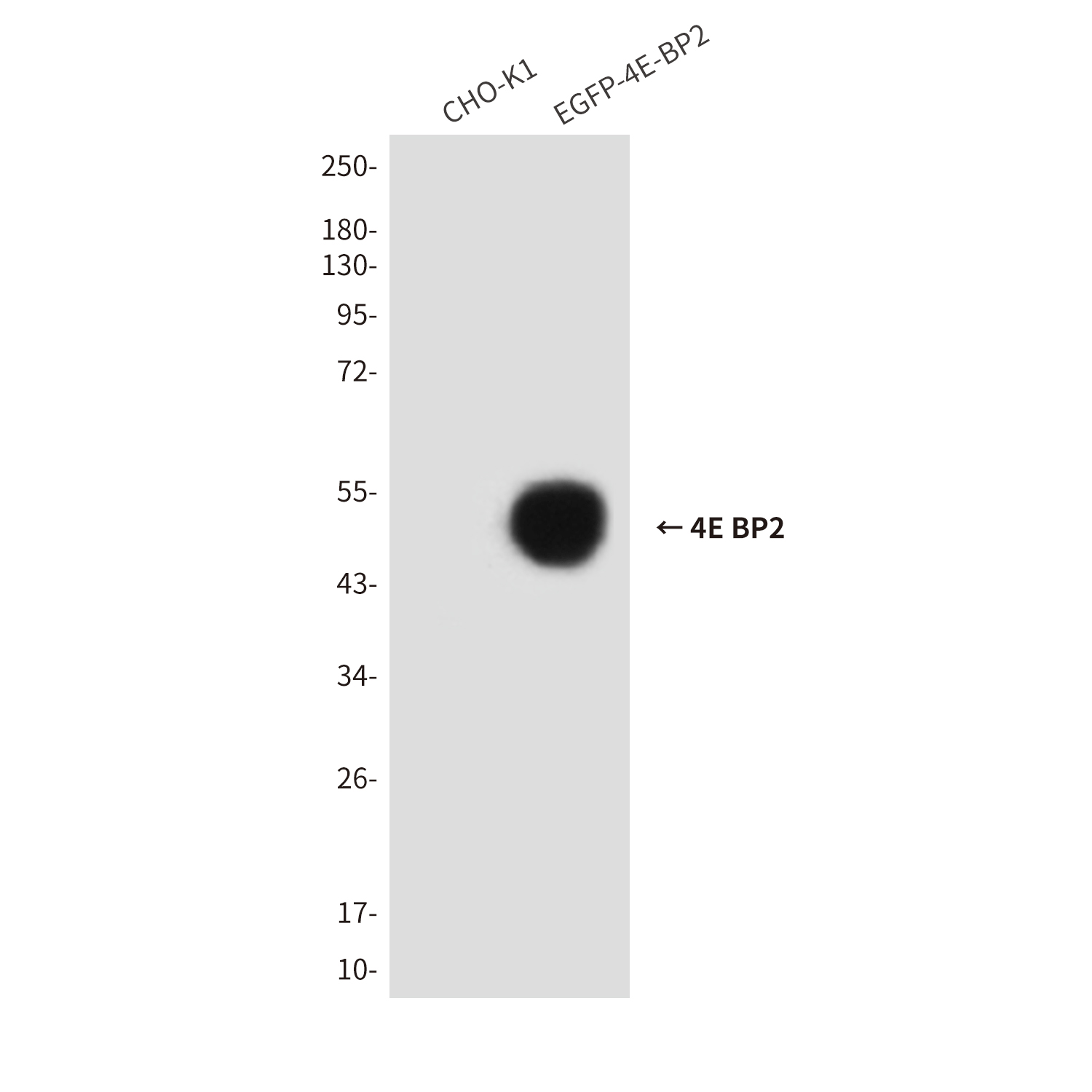

Anti-4E BP2 antibody [7A6-B3-E5] (STJA0032488)
SPECIFICATIONS
ClonalityMonoclonal
HostMouse
ConjugationUnconjugated
IsotypeIgG1
ImmunogenRecombinant protein of human 4E-BP2.
General Information
| Short Description | Mouse monoclonal anti-4E BP2 for use in WB in Transfected samples. Datasheet included with dilution recommendations, and related reagents. |
| Applications | WB |
| Host | Mouse |
| Reactivity | Transfected |
| Note | STRICTLY FOR FURTHER SCIENTIFIC RESEARCH USE ONLY (RUO). MUST NOT TO BE USED IN DIAGNOSTIC OR THERAPEUTIC APPLICATIONS. |
Product Properties
| Clonality | Monoclonal |
| Clone ID | 7A6-B3-E5 |
| Isotype | IgG1 |
| Conjugation | Unconjugated |
| Concentration | 5.66 mg/mL |
| Purification | Affinity Purified |
| Dilution Range | WB 1:500-1:1000 |
| Formulation | Liquid in PBS containing 50% glycerol, 0.5% BSA and 0.02% sodium azide, pH 7.3. |
| Storage Instruction | Store at 4°C short term. Aliquot and store at-20°C long term. Avoid freeze/thaw cycles. |
Target Information
| Gene Symbol | EIF4EBP2 |
| Gene ID | 1979 |
| Uniprot ID | 4EBP2_HUMAN |
| Immunogen | Recombinant protein of human 4E-BP2. |
Additional Info
| Post Translational Modifications | Phosphorylation at Thr-37, Thr-46, Ser-65, Thr-70 and Ser-83 is mediated by MTOR and corresponds to the hyperphosphorylated form: it abolishes binding to EIF4E by inducing folding of intrinsically disordered regions. First phosphorylated at Thr-37 and Thr-46 by MTOR, inducing folding of region encompassing residues from Pro-18 to Arg-62 of into a four-stranded beta-domain that sequesters the helical YXXXXLPhi motif into a partly buried beta-strand, blocking accessibility to EIF4E. Protein phosphorylated at Thr-37 and Thr-46 is however unstable and subsequent phosphorylation at Ser-65, Thr-70 and Ser-83 is required to stabilize the fold, decreasing affinity for EIF4E by a factor of 4000. Phosphorylated in response to insulin, EGF and PDGF. Deamidated at Asn-99 and Asn-102 to aspartate (Asp) in brain. Deamidation promotes interaction with RPTOR, subsequent phosphorylation by mTORC1 and increased translation, leading to impair kinetics of excitatory synaptic transmission. Deamidation takes place during postnatal development, when the PI3K-Akt-mTOR signaling is reduced, suggesting it acts as a compensatory mechanism to promote translation despite attenuated PI3K-Akt-mTOR signaling in neuron development. Deamidation converts Asn residues into a mixture of Asp and isoaspartate.interactions with PCMT1 is required to prevent isoaspartate accumulation and convert isoaspartate to Asp. |
| Function | Repressor of translation initiation involved in synaptic plasticity, learning and memory formation. Regulates EIF4E activity by preventing its assembly into the eIF4F complex: hypophosphorylated form of EIF4EBP2 competes with EIF4G1/EIF4G3 and strongly binds to EIF4E, leading to repress translation. In contrast, hyperphosphorylated form dissociates from EIF4E, allowing interaction between EIF4G1/EIF4G3 and EIF4E, leading to initiation of translation. EIF4EBP2 is enriched in brain and acts as a regulator of synapse activity and neuronal stem cell renewal via its ability to repress translation initiation. Mediates the regulation of protein translation by hormones, growth factors and other stimuli that signal through the MAP kinase and mTORC1 pathways. |
| Protein Name | Eukaryotic Translation Initiation Factor 4e-Binding Protein 24e-Bp2Eif4e-Binding Protein 2 |
| Database Links | |
| Cellular Localisation | CytoplasmNucleus |
| Alternative Antibody Names | Anti-Eukaryotic Translation Initiation Factor 4e-Binding Protein 2 antibodyAnti-4e-Bp2 antibodyAnti-Eif4e-Binding Protein 2 antibodyAnti-EIF4EBP2 antibody |
Information sourced from Uniprot.org