


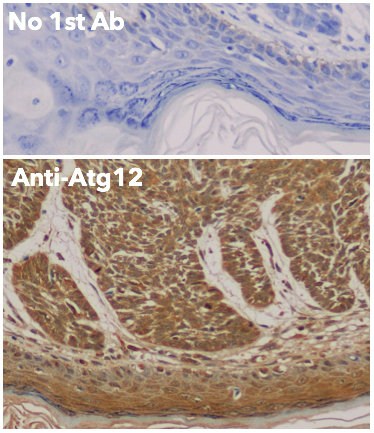
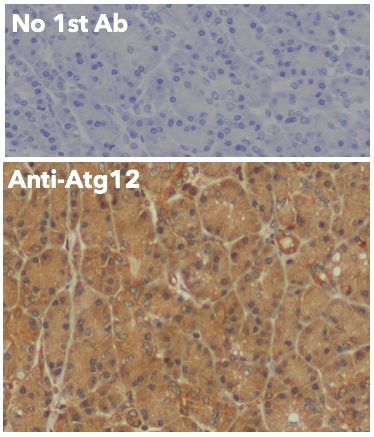
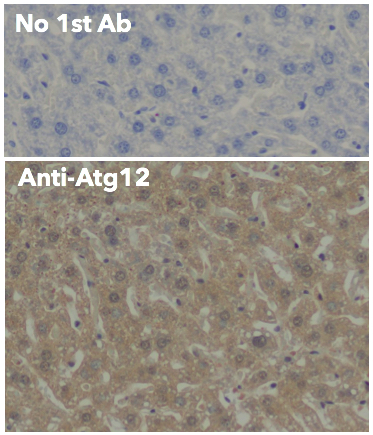
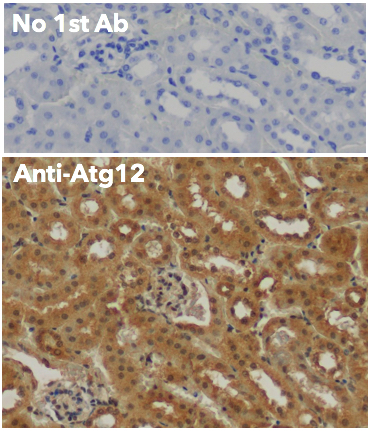


Anti-ATG12 antibody (65aa N-Term) (STJ140014)
SPECIFICATIONS
ClonalityPolyclonal
HostGoat
ConjugationUnconjugated
IsotypeIgG
ImmunogenPurified recombinant peptide within residues 65 aa to the N-terminus of human ATG12 produced in E. coli.
General Information
| Short Description | Goat polyclonal Autophagy related 12 (65aa N-Term) antibody for use in WB and IF in human, mouse, rat, bovine, canine, chicken, avian, donkey, feline, goat, guinea pig, hamster, horse, porcine, rabbit, sheep and simian samples. Datasheet included wit |
| Applications | WB/IF |
| Host | Goat |
| Reactivity | Human/Mouse/Rat/Bovine/Canine/Chicken/Avian/Donkey/Feline/Goat/Guinea Pig/Hamster/Horse/Porcine/Rabbit/Sheep/Simian |
| Note | STRICTLY FOR FURTHER SCIENTIFIC RESEARCH USE ONLY (RUO). MUST NOT TO BE USED IN DIAGNOSTIC OR THERAPEUTIC APPLICATIONS. |
Product Properties
| Clonality | Polyclonal |
| Isotype | IgG |
| Conjugation | Unconjugated |
| Concentration | 3 mg/mL |
| Purification | This antibody is epitope-affinity purified from goat antiserum. |
| Dilution Range | WB 1:250-1:2000IF 1:50-1:250IHC-F 1:200-1:1000IHC-P 1:200-1:1000Kharaziha P Panaretakis T. Methods Enzymol. 2017:587:247-255. PMID: 28253959 |
| Formulation | PBS, 20% Glycerol and 0.05% Sodium Azide. |
| Storage Instruction | For continuous use, store at 2-8 C for one-two days. For extended storage, store in-20 C freezer. Working dilution samples should be discarded if not used within 12 hours. |
Target Information
| Gene Symbol | ATG12 |
| Gene ID | 9140 |
| Uniprot ID | ATG12_HUMAN |
| Accession Number | ENSG00000145782 |
| Immunogen | Purified recombinant peptide within residues 65 aa to the N-terminus of human ATG12 produced in E. coli. |
| Immunogen Region | 65aa N-Term |
| Immunogen Sequence | AEEPQSVLQLPTSIAAGGEG EEPQSVLQLPTSIAAGGEGL EPQSVLQLPTSIAAGGEGLT |
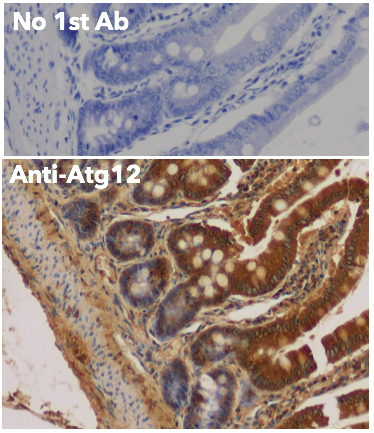
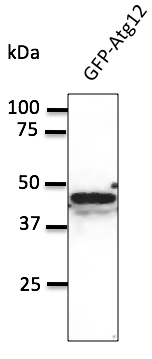
| Specificity | Detects GFP-ATG12 in transfected cells by Western blot. |
Additional Info
| Tissue Specificity | Ubiquitous. |
| Post Translational Modifications | Acetylated by EP300. |
| Function | Ubiquitin-like protein involved in autophagy vesicles formation. Conjugation with ATG5 through a ubiquitin-like conjugating system involving also ATG7 as an E1-like activating enzyme and ATG10 as an E2-like conjugating enzyme, is essential for its function. The ATG12-ATG5 conjugate acts as an E3-like enzyme which is required for lipidation of ATG8 family proteins and their association to the vesicle membranes. As part of the ATG8 conjugation system with ATG5 and ATG16L1, required for recruitment of LRRK2 to stressed lysosomes and induction of LRRK2 kinase activity in response to lysosomal stress. (Microbial infection) May act as a proviral factor. In association with ATG5, negatively regulates the innate antiviral immune response by impairing the type I IFN production pathway upon vesicular stomatitis virus (VSV) infection. Required for the translation of incoming hepatitis C virus (HCV) RNA and, thereby, for the initiation of HCV replication, but not required once infection is established. |
| Protein Name | Ubiquitin-Like Protein Atg12Autophagy-Related Protein 12Apg12-Like |
| Database Links | Reactome: R-HSA-1632852Reactome: R-HSA-5205685Reactome: R-HSA-8934903Reactome: R-HSA-936440 |
| Cellular Localisation | CytoplasmPreautophagosomal Structure MembranePeripheral Membrane ProteinTecpr1 Recruits The Atg12-Atg5 Conjugate To The Autolysosomal Membrane |
| Alternative Antibody Names | Anti-Ubiquitin-Like Protein Atg12 antibodyAnti-Autophagy-Related Protein 12 antibodyAnti-Apg12-Like antibodyAnti-ATG12 antibodyAnti-APG12 antibodyAnti-APG12L antibody |
Information sourced from Uniprot.org